All the Words Donald Trump is Taking Out of Use Within Anything Controlled By the Government

Written By: Grace Mintun
April 23rd, 2025
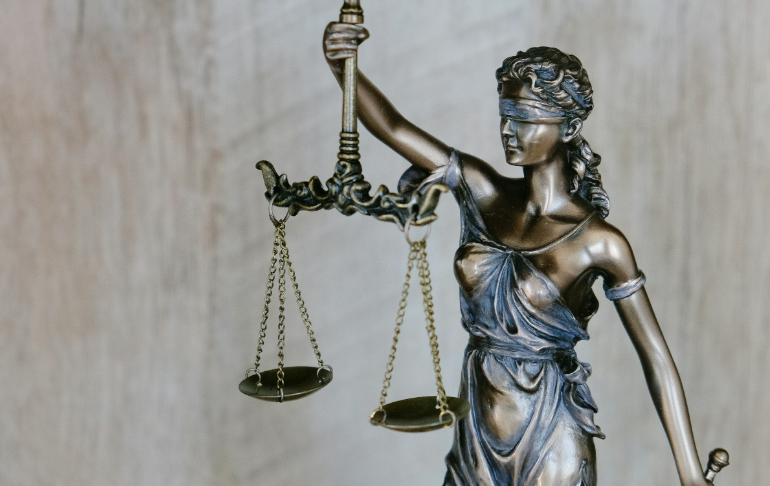
Mick Haupt via UnsplashTrump and his administration are removing these words and phrases from anything government related. This includes but is not limited to laws, school curriculum, websites, and grants. Words are powerful, and Trump knows this. Removing these words from government is the first step to taking that power.
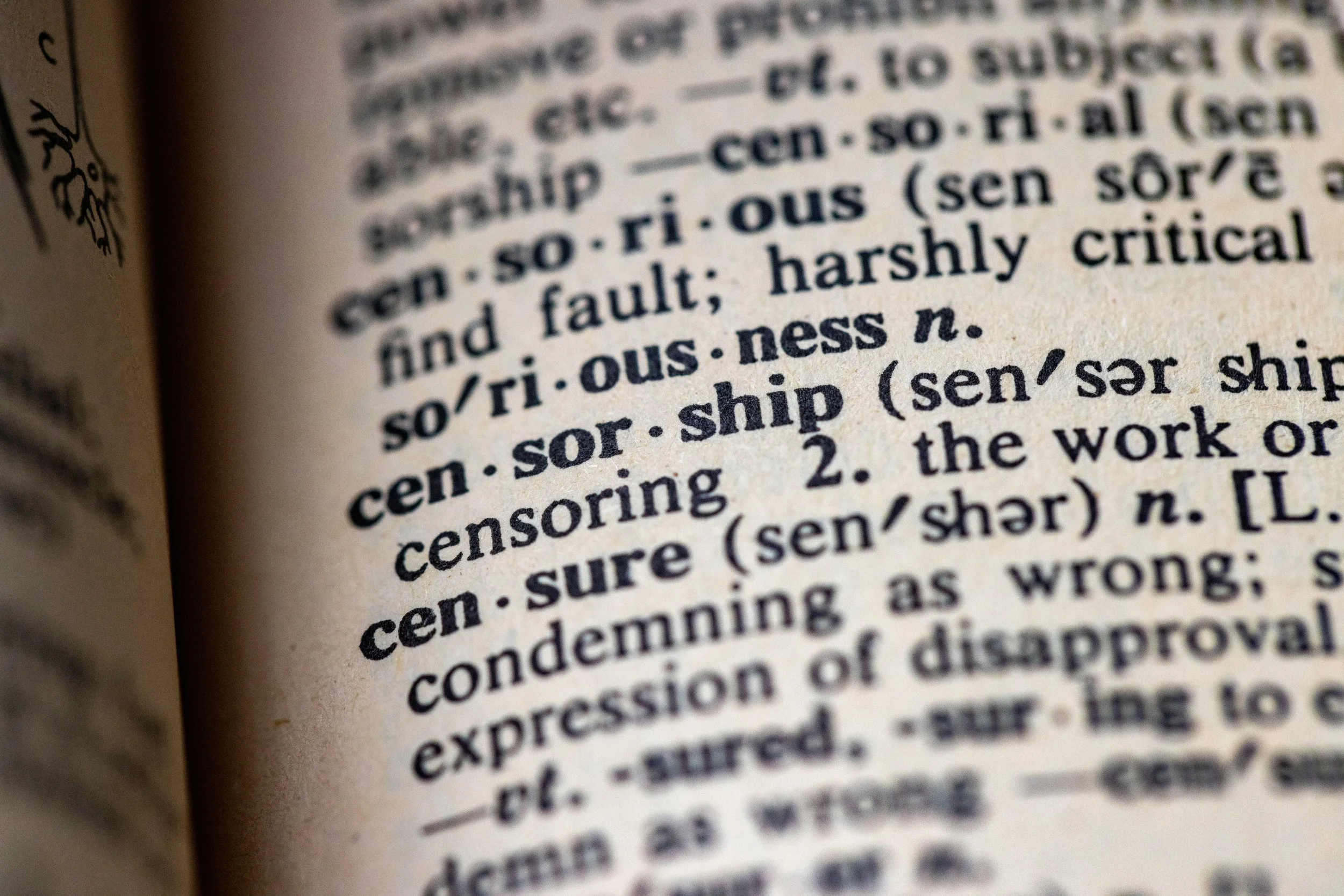
So, instead of writing about how these words and phrases are important, which they are, I will be doing a dual-pronged approach. One, defining these words. I was always told by my parents to keep a physical dictionary around, as definitions can easily change digitally (or even in print, if the change is over a long term) by those in power. So I will be using the Oxford English Dictionary, said by Harvard to be “widely accepted as the most complete record of the English language ever assembled. Unlike typical language dictionaries, which only define words in terms of their current uses and meanings, the OED is a historical dictionary.” I can’t define them all because this list would be the length of multiple articles, but I defined the ones which stood out the most to us at Necessary Behavior. Two, in my article at the end of the week, I will be taking a speech made by American heroes taught in school today, that can no longer be taught because these words are in it - while crossing out the words that are now controlled. Because the first step to controlling our freedom is limiting what we can discuss. Now, let’s begin, shall we?
Here are just a few of the words that stood out to us:
Accessible - Able to be received, acquired, or made use of; open or available (to a particular class of person). Able to be (readily) understood or appreciated. Capable of being used as an access; affording entrance or a means of approach. Also in figurative contexts. Capable of being conveniently used or accessed by people with disabilities; of or designating goods, services, or facilities designed to meet the needs of disabled people.
Activism - The policy of active participation or engagement in a particular sphere of activity; spec. the use of vigorous campaigning to bring about political or social change.
Assigned female at birth/assigned male at birth (assigned at birth or birth-assigned) - (Of sex or gender) that is assigned to a person at birth; designating the gender assigned at birth.
At risk - That is exposed to the possibility of loss, harm, or other adverse or unwelcome circumstance
Black - Designating a member of any dark-skinned group of peoples, esp. a person of sub-Saharan African origin or descent. Also (esp. Australian): designating a person of Australian Aboriginal origin or descent. Of or relating to black people, their history, politics, culture, etc. Of an area or place: predominantly inhabited or frequented by black people. Designating the black population of a specified country or region, esp. as a cultural or political entity.
Disability - A physical or mental condition that limits a person's movements, senses, or activities; (as a mass noun) the fact or state of having such a condition
Ethnicity - Status in respect of membership of a group regarded as ultimately of common descent, or having a common national or cultural tradition; ethnic character
Female - A female person; a woman or girl. Belonging to female sex or gender.
Gender - The state of being male or female as expressed by social or cultural distinctions and differences, rather than biological ones; the collective attributes or traits associated with a particular sex, or determined as a result of one's sex. Also: a (male or female) group characterized in this way.
Historically - Forming adjectives with the sense ‘historical and ——’ or ‘historically, as applied to history’
Immigrants - A person who comes to settle permanently in another country or region.
LGBTQ - Lesbian, gay, bisexual, transgender, and queer
Political - Of, belonging to, or concerned with the form, organization, and administration of a state, and with the regulation of its relations with other states. Involved, employed, or interested in politics; that takes a side, promotes, or follows a particular party line in political debate. Also (somewhat derogatory): having regard to or affected by the interests of a party or parties rather than principle; partisan, factious. Relating to or concerned with public life and affairs as involving questions of authority and government; relating to or concerned with the theory or practice of politics.
Pollution - Physical impurity or contamination; (now) esp. the presence in or introduction into the environment (esp. as a result of human activity) of harmful or poisonous substances, or excessive levels of light, noise, organic waste, etc.
Pronoun - A word that can function as a noun phrase when used by itself and that refers either to the participants in the discourse (e.g. I, you) or to someone or something mentioned elsewhere in the discourse (e.g. she, it, this). Pronouns: I, you, he, she, it, we, they, me, you, him, her, it, us, them, mine, yours, his, hers, its, ours, theirs, myself, yourself/yourselves, himself, herself, itself, ourselves, themselves, myself, yourself/yourselves, himself, herself, itself, ourselves, themselves, this, that, these, those, who, whom, whose, which, that, who, whom, whose, which, what, any, each, either, neither, some, someone, anyone, everyone, no one, something, anything, everything, nothing, each other, one another
Race - An ethnic group, regarded as showing a common origin and descent; a tribe, nation, or people, regarded as of common stock. A group of people, animals, or plants, connected by common descent or origin. A group of people belonging to the same family and descended from a common ancestor; a house, family, kindred. According to various more or less formal attempted systems of classification: any of the (putative) major groupings of humankind, usually defined in terms of distinct physical features or shared ethnicity, and sometimes (more controversially) considered to encompass common biological or genetic characteristics.
Racism - Prejudice, antagonism, or discrimination by an individual, institution, or society, against a person or people on the basis of their nationality or (now usually) their membership of a particular racial or ethnic group, typically one that is a minority or marginalized. Also: beliefs that members of a particular racial or ethnic group possess innate characteristics or qualities, or that some racial or ethnic groups are superior to others; an ideology based on such beliefs.
Segregation - The separation or isolation of a portion of a community or a body of persons from the rest. The enforced separation of different racial groups in a country, community, or institution.
Stereotype - To view or portray (a person) as having characteristics corresponding to a widely-held but oversimplified or prejudiced preconception of the group to which they belong.
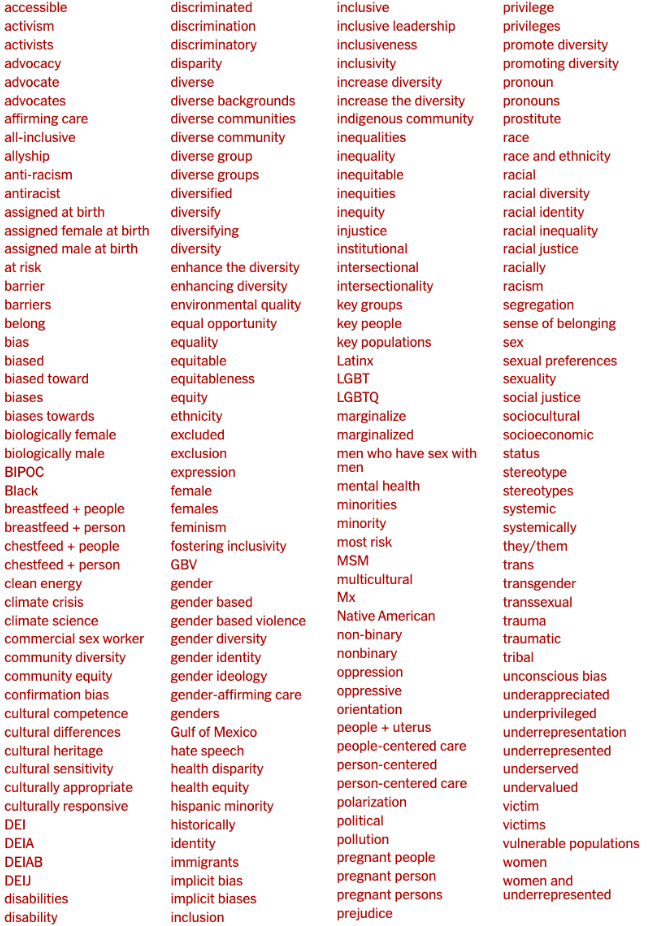
These are words and phrases that are being limited, avoided, flagged, removed, or cautioned from use from all governmental use including public-facing websites, school curricula, grant proposals, contracts, and more with both official and unofficial agency guidance by government memos - all without instituting an outright ban. These are just words that have been flat-out stated, and not ones that have beaten around the bush of what is now “impermissible” to say.
In the book 1984, written in 1946 in reflection of World War Two, the Nazi Party and Hitler’s regime, George Orwell portrayed “totalitarian systems control[ing] language in order to prevent their citizens from expressing or thinking rebellious thoughts, writing ‘If thought corrupts language, language can also corrupt thought’”.
If this isn’t controlling language, I don’t know what is.
“The most basic component of freedom of expression is the right to freedom of speech. Freedom of speech may be exercised in a direct (words) or a symbolic (actions) way. Freedom of speech is recognized as a human right under article 19 of the Universal Declaration of Human Rights . The right to freedom of speech allows individuals to express themselves without government interference or regulation.”
A word would not exist if it wasn’t important. Language is never something that should be taken away. The average American only uses 20,000 to 35,000 words of the English language out of a possible minimum of 170,000 words. We are slowly losing our lexicon as is. Removing words at a government level isn’t helping our illiteracy problem.
By doing this, they’re removing history, removing language. They’re removing our speech. Words are our own; they are owned by no man, government, or idea. These words are being removed quietly, under a hush. “Donald Trump didn’t say that,” you cry. “They aren’t actually banned,” you say. No, they’re just being removed from everything the government is involved in—which includes our laws, justice system, schools, and so many other facets of our lives. Why would they shout from the rooftops that they’re taking away our rights?
Written by: Grace Mintun
About the author: A writer and Twitch streamer dedicated to promoting kindness and breaking down stigma around mental health and disabilities!
Censorship, Trump Administration, Banning
Check out our social media for more resources:
Additional Reading

Sources
https://www.nytimes.com/interactive/2025/03/07/us/trump-federal-agencies-websites-words-dei.html
https://www.law.cornell.edu/wex/first_amendment
https://newrepublic.com/article/192631/trump-speech-code-deleted-words
https://pen.org/banned-words-list/
https://www.silive.com/politics/2025/03/here-are-the-words-being-removed-from-government-websites-at-trumps-directive.html
https://dianeravitch.net/2025/03/08/trumps-list-of-banned-words-its-worse-than-you-thought/
https://www.npr.org/2025/04/14/nx-s1-5349473/trump-free-speech-science-research
https://gizmodo.com/the-list-of-trumps-forbidden-words-that-will-get-your-paper-flagged-at-nsf-2000559661
https://babel.ua/en/news/116073-women-activism-and-equality-the-trump-administration-banned-or-restricted-the-use-of-hundreds-of-words
Leave a comment