Ariana Grande and the “Weight Loss” Conversation We’re Not Having
Written By: Jacqueline Salazar Romo
Date: August 17th, 2026
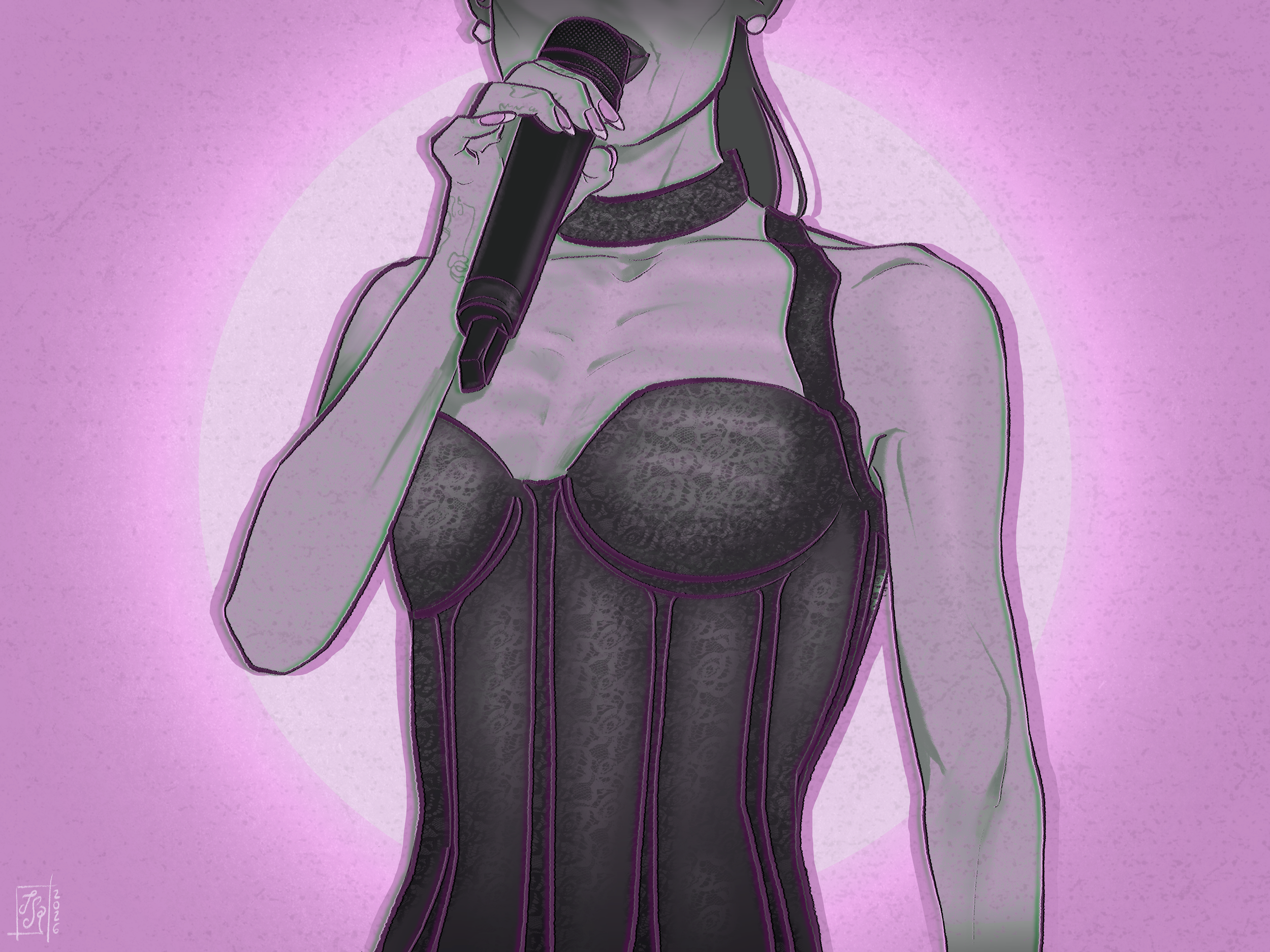
(Digital illustration by author)I’ve never been an active Ariana Grande listener or a habitual music video watcher of hers. But like most people, I have come to witness Grande’s musical and acting career evolve for well over a decade, from fun quips on Victorious to Wicked Oscar nominations and all the Grammys in between. Regardless of how you feel about her, Grande is a household name, an otherworldly popular artist with millions of fans worldwide. So when I saw that clips from the video for the popstar’s latest single, “Petal,” were circulating online, I was compelled to examine it… for perhaps the wrong reasons.
“Petal” opens with Grande’s in-video character Pepper, an aspiring actress in the big city. Doe-eyed and optimistic, Pepper enters an audition and puts on an enthusiastic performance for a quartet of jaded older talent scouts, all to receive a “NOT GOOD ENOUGH” stamped on their scathing notes. She continues trying out for this role under different personas, becoming more desperate with each rejection. The tensions culminate when the men disparage her brazenly and tell her that they miss the “old” her, “the way [she] used to be.” The scene cuts to sharp silhouettes against a glaring red background as an overwhelmed Pepper revs up a chainsaw and murders her critics. The video ends with the other women who were auditioning congratulating a bloodsoaked Pepper for ending the cycle.
The music video’s message is easy to deduce: Ariana is “clapping back” at the haters and standing up to a toxic industry and fanbase, unapologetic about her new music era: “’Cause all of my favorite stories / End in some kind of catastrophe / But I don’t need someone to save me / ’Cause this music and I will never die.” But for a song that should be confident and triumphant, the comment section tells a different story. One YouTube user after another voices their concern for the popstar’s well-being, with each of these sentiments garnering tens of thousands of likes. And despite the eye-catching visuals of the short film, some scenes stand out more than most—one of which is Grande in a sultry black, off-the-shoulder dress winking flirtatiously at the talent scouts, twirling around and accentuating the outline of her sternum, her protruding shoulder blades, and her worryingly thin frame. Following increased “backlash” and speculation about her health, a representative for Ariana Grande told PEOPLE that she would be stepping back from public-facing work after her Eternal Sunshine Tour concludes this September 1st.
When looking at the online discussions about the global superstar, I encountered plenty of discourse in the comments of anyone bringing up Grande’s weight. One of the most prominent rebuttals against these conversations was the belief that no one should make public comments about a stranger’s perceived health, let alone a celebrity’s. And on the one hand, this argument may come from a place of newfound compassion: after the passing of beloved actor Chadwick Boseman in 2020 from stage IV colon cancer, an illness he had kept private for four years, many online users regretted having body-shamed the actor—but it was too little, too late. By the time his death had been announced, there had been thousands of cruel speculative comments about his semblance, tabloids sensationalizing his sickly and thin frame, and people cracking jokes about drug-related weight loss. A lesson was learned from Boseman’s tragic death: it is abhorrent to bring up someone’s physical appearance when their health conditions are not disclosed. But is it the right lesson to apply to this context?
Just as it is true that we cannot possibly know someone’s state of mind or overall health from their physical appearance alone (nor are we entitled to make disparaging comments and assumptions about anybody’s physical attributes), it is also true that important conversations about weight and eating disorders are being ignored under the guise of “protecting” celebrities. Moreover, it has always been more culturally acceptable to correlate higher body mass to increased health problems, even when studies have shown that being mildly overweight does not pose a significant increase in mortality risk. But the same cannot be said about being underweight, especially with the prevalence of eating disorders that propel these conditions. The National Association for Anorexia Nervosa and Associated Disorders (ANAD) has estimated that around 9% of the U.S. population will have an eating disorder in their lifetime, and anorexia nervosa—characterized by obsessive food restriction and the intense fear of weight gain—has “the second-highest crude mortality rate of any mental illness,” surpassed only by opioid/substance use disorders. But it doesn’t stop there: the National Eating Disorders Association (NEDA) corroborates these statistics alongside research by both the Miami University and Auburn University’s departments of psychology. These studies show that suicidal behavior is elevated in those with eating disorders, including bulimia and binge eating disorder, and that individuals with anorexia are 18 times more likely to commit suicide relative to comparison groups that do not suffer from said mental illness.
Drastic weight fluctuations in either direction (meaning, being either too thin or significantly obese) are conducive to more illness and a decreased life expectancy—so why are concerns about someone’s health never treated with the same seriousness if they are thin and not overweight?
We also cannot have this conversation without acknowledging the psychological toll that global stardom, especially stardom that begins at an early age, can have on a celebrity. While Grande has been generally quiet about her early experiences on-set, Sam & Cat co-star Jennette McCurdy’s memoir I’m Glad My Mom Died in 2022 invited conversations about the horrible abuse that child stars are often forced to live through. More recently, actress Jenna Ortega’s Esquire interviewwas eye-opening in a similar way. When recalling her own experiences as a child star, Ortega spoke of how determined she was to not inconvenience the adults around her: “I would go all day without eating, drinking, whatever because I wanted so badly to not be in the way of everybody… Maybe that was my mistake, I was not actually looking after myself.” Her appearance in the Esquire video also caught people’s attention online: Ortega looks noticeably thinner (Wednesday star’s sister Aliyah has since come online to defend her sibling and tell people to “mind [their] business”). And the speculation around Grande’s weight is unfortunately nothing new—comments about her body have been shared since she has been in the public eye. But as more and more celebrities strut red carpets with sunken cheeks and skeletal frames, it’s clear that this is not just about her. As of late, there has been a pattern as one female celebrity after another garners attention for the same reasons Ariana did. While headlines often praise their appearances, their collarbones protrude, their eyes look tired and dull, and their faces are angular and gaunt. Seeing these public figures who are upheld as epitomes of grace and beauty wilting away in front of our eyes doesn’t seem like something we should be ignoring. And headlines praising Demi Moore’s“toned arms” when you can make out every bone in her body, or blindly encouraging you to go on Ozempic because that’s how your favorite celebrity lost weight, are not headlines that should be celebrated. Notorious for being especially harsh to its female stars, the entertainment industry is failing these women who deserve to be supported and helped, and it does everything to normalize a correlation of self-worth with the numbers on a scale.
Weight loss culture and celebrity worship have created a hostile environment in which showing concern for someone’s physical health is perceived as an attack on that individual’s personhood and autonomy. But these whataboutisms are not productive or empowering. Conflating genuine concern with body-shaming is dangerous, especially as it relates to weight and its associated issues. And while discourse surrounding the ultra-famous may not affect their decisions, the entertainment industry’s normalization of extreme thinness is sure to reach and influence more impressionable viewers—the vast majority of whom do not have the resources or support system to overcome eating disorders or body dysmorphia, and who will learn to see that extreme, unhealthy degree of thinness as glamorous and aspirational.
I want to make it abundantly clear that I am not advocating for the harassment of these public figures by any means. No concerned person with good intentions is trying to body-shame Ariana Grande, or any other celebrity for that matter (I would even argue that most of the comments fixating on these women’s weight loss do come from fans who love and appreciate them, their talents, and their beauty). It’s also not productive to accuse these celebrities of being entirely culpable when it comes to propagating unrealistic body standards, which have (historically) disproportionately and unfairly targeted women. But acknowledging these worrying trends towards extreme thinness can—and should—allow us to talk about how negatively impactful and even morally reprehensible these beauty metrics are. The body positivity movement is out and the 90s’ heroin chic fad is making a comeback, and we need to be prepared to have difficult conversations about weight if we are to overcome these dangerous ideals.
———
If you or anyone you know is showing signs of disordered eating and/or heightened distress when it comes to gaining/losing weight, help and support are available through organizations and resources like the ones listed below. In a culture that wants you to think that you need to starve yourself to matter, you deserve to be appreciated for more than your waist measurements or your sharp collarbones. You and your overall health are far more important than your weight—don’t let anyone convince you otherwise.
National Association of Anorexia Nervosa and Associated Disorders (ANAD)
Learning Library
Treatment Directory
Helpline (toll-free): 1(888) 375-7767
National Alliance for Eating Disorders
Email: referrals@allianceforeatingdisorders.com
Helpline: 1(866) 662-1235
National Alliance for Mental Illnesses (NAMI)
Email: info@nami.org
Helpline: 1-800-950-NAMI (6264)
NAMI Connection Support Group
National Eating Disorder Association (NEDA)
Written by: Jacqueline Salazar Romo
About the Author: Jacqueline is an editorial staff member at NB who often explores the intersections of identity, belonging, and culture in relation to current events. Whenever she isn't writing, she enjoys art, fandom, and thinking too long about the past.
Eating Disorders, Entertainment Industry, Weight Loss Culture
Check out our social media for more resources:
Additional Reading
Sources:
https://youtu.be/afSgBNwmZrQ?si=SA7bgARlEXyTxcyr
https://katiecouric.com/health/mental-health/ariana-grande-weight-eating-disorder/
https://pmc.ncbi.nlm.nih.gov/articles/PMC8277405/
https://anad.org/learning-library-old/eating-disorder-statistic/
https://www.wsj.com/lifestyle/ariana-grande-thinness-commenting-body-positivity-9793a9a0
https://heatherhayes.com/the-dangerous-revival-of-heroin-chic/
https://www.cnn.com/2026/08/03/entertainment/ariana-grande-weight-body-cec
https://anad.org/learning-library-old/eating-disorder-statistic/#general
https://www.sciencedirect.com/science/article/abs/pii/S2352250X17301859?via%3Dihub
https://www.nationaleatingdisorders.org/eating-disorders-and-suicide/
https://pmc.ncbi.nlm.nih.gov/articles/PMC12904099/
https://people.com/celebrities-ozempic-wegovy-what-theyve-said-12050794
Understanding ARFID: The Unknown Eating Disorder
Leave a comment