
Inside the Death Zone: Just Because We Can Doesn’t Mean We Should
There is a place on earth where the air is so thin, the weather so brutal, the peaks so jagged, that it is commonly referred to by mountaineers and adventurers as “The Death Zone,” So named because of this extreme altitude—anything above 8,000 meters (26,200 feet)—that the environment cannot sustain human life. Ironically, this same horrific place is also facing something akin to the likes of Disneyland and the Trevi Fountain: overtourism.
According to the European Parliament of 2018, the definition of overtourism is as follows: the situation in which the impact of tourism, at certain times and in certain locations, exceeds physical, ecological, social, economic, psychological, and/or political capacity thresholds. In the case of Everest, the economic benefit of mountaineering is being prioritized at the expense of the ecological component and cultural significance of the mighty mountain. To climb the mountain, either from the Nepalese (south) side or the Tibetan (north) side, climbers are required to spend thousands of dollars on permits, paid to the respective governing bodies.
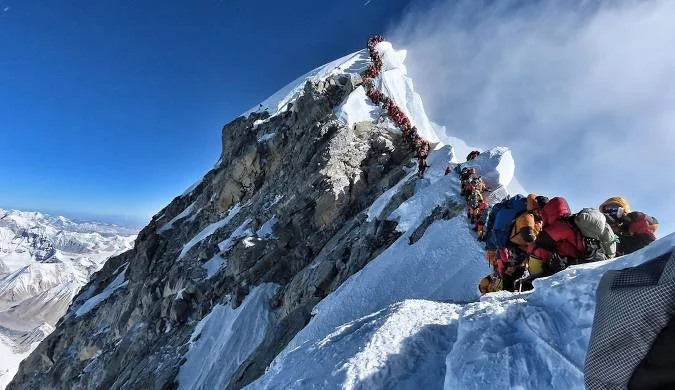
Mount Everest, its Nepali name, Sagarmatha, is the highest point on earth. This label of extremity incentivizes and then causes a growing group of people to ascend its slopes every climbing season (extreme weather and elevation limits the season to just the months of April and May - outside of that window, the climbing conditions are too difficult) seeking the ability to claim that they stood “on top of the earth”. The problem is, it's becoming too crowded. In recent decades, the mountain has become overrun with summit attempts. Climbers have even reported lines up to the top, where each person has to wait their turn to summit, often for hours at a time. Alongside this increase in people, comes an increase in their waste. At Base Camp (17,000 feet in elevation), where a majority of climbers begin their summit attempt, there are large piles of trash and human waste left behind from the past climbers.
The numbers don’t lie. In order to attempt a summit, climbers need permits. Just this past 2025 spring season, the mountain saw many new records: the Nepalese government issued a record 468 permits and the Nepalese/Chinese government issued approximately 100. And these are just the initial permits. On top of that, climbers have to buy copious amounts of gear, transportation to Kathmandu, and pay for expedition guides, either through private expedition companies, or more commonly, through local Sherpa guides.
The Sherpa people, the native people in the Nepalese Himalayas, have been scaling the surrounding mountains for centuries. Genetically more suited for high altitude, this dwindling ethnic group is often hired out as guides by both private mountaineering expeditions and the Nepalese and Chinese governments. The Sherpas guide climbers over the ice, help them plan expeditions, and they even carry their followers’ gear (sometimes they carry luxuries, like dining tables). Their job is to summit alongside the Western climbers, lay ropes, and bring them home safely, to the best of their ability.
These Sherpas make their livelihood within this annual two month window of a summit season, essential for economic growth. According to research conducted by Chandra Prasad Dhakal, PhD, an assistant Professor of Economics at Tribhuvan University in Nepal, the tourism industry in Nepal earned 71.7 million USD in revenue, just in 2023. A significant chunk of the countries’ GDP, the Sherpas and the government rely on that revenue, primarily from climbers from the west. Especially for the Sherpa’s who live higher up in the Himalayas, in smaller villages where jobs and opportunities are scarce, the two-month climbing season is often how they earn a large majority of their yearly wages.
As more and more wealthy, in-experienced climbers catch on to the trend, their lack of mountaineering exposure increases the Sherpa’s workload, in turn increasing the danger of the expedition. The more amateur the climber, the more danger the Sherpa is in. In addition, the long hours, exposure to the formidable cold and wind, and time spent in a thinning atmosphere, all add to the level of peril the guides are put in. The increase in climbers on Everest suggests that those with the extra funds and lack of experience, are failing to consider the dangerous circumstances their commission is putting the native Himalayan people in.
It is here that debate rises: which is the lesser of two evils? Economic damage, or environmental and social damage? Is there a solution that does away with both? Under a majority capitalist world, likely not.
So we might look to the west for a solution. It may be that the hubris of mankind causes us to believe we can conquer every height. And maybe we can. That does not mean we, as humans, belong there. There is a line from the 1993 film, Jurassic Park, where Jeff Goldblum’s character coyly remarks, “Yeah, but your scientists were so preoccupied with whether or not they could that they didn’t stop to think if they should.” Though we're not dealing with the return of the dinosaur species, this sentiment only replicates itself on the mountain. Just because we can (even with great difficulty) reach the top of earth, maybe we aren’t supposed to? If we have to harm the earth and exploit certain populations just to do so, maybe it is not worth it. But to make that call is to sacrifice the economy of Nepal and Tibet.
Perhaps, there is no concrete solution to this, but a multitude of steps need to be taken. Perhaps the government, in addition to raising the price of climbing permits, limits the amount of permits issued per climbing season. We’re already seeing this foresight take place within the East especially in regards to waste management. Also, in April of 2025, Nepal introduced an Integrated Tourism Bill to their upper house of parliament, requiring that permits only be issued to climbers who have already climbed a mountain of at least 7,000 meters in height. In other words, if the bill passes, you not only have to buy your way onto the mountain, you now also have to earn your way onto it.The goal is to reduce the negative footprint left by climbers, allowing only serious and elite mountaineers to attempt to conquer the nearly impossible. It also makes it safer for the Sherpa’s hired to guide them, as they aren’t risking their lives guiding rookie climbers.
These steps are the first of many, and it is worth repeating that Western mountaineers also have an obligation to the mountain: determining the necessity of their ascent, and weighing the repercussions of every step they take. The decision to climb Everest is not a self-contained one—an impact will always be felt.
Sources:
(PDF) OVERTOURISM: Definition and Impact
Ovrtourism: Definitions, Enablers, Impacts and Managerial Challenges | SpringerLink
Chandra Prasad Dhakal, PhD 1Assist. Professor of Economics, Tribhuvan University
Everest 2025: Welcome to Everest 2025 Coverage | The Blog on alanarnette.com
Nearly 800 summits mark busy, stormy Everest season
Mount Everest Is Turning into a Garbage Dump | Earth.Org
Do You Need a Permit to Climb Mount Everest? – Adventure Himalaya
Why Some Sherpas Say There Won’t Be Any Guides On Everest In 10 Years | Inside Everest
Check out our social media for more resources: Facebook, Instagram, Twitter, Tumblr
And you can find more articles like this on Lemon-Aid
Written By: Erin Coveny | July 10, 2025