
Revisiting Literary Classics: Dissecting the Queer Undertones of Little Women
Written by: Jacqueline Salazar Romo
May 15, 2025
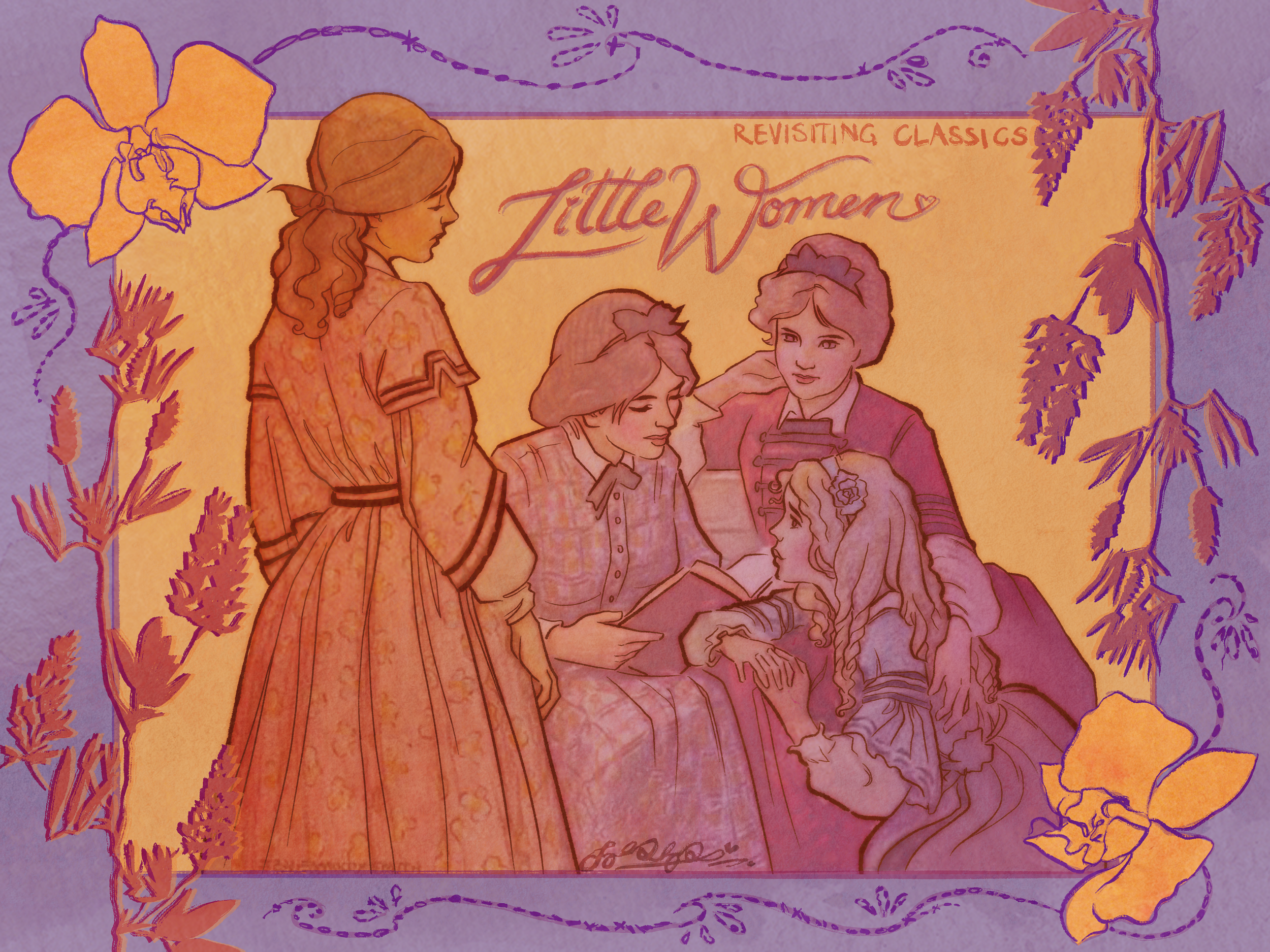
Meg, Jo, Beth, and Amy; these are the names of four girls that would be immortalized in American literature. Through a trove of sequels and adaptations across the 157 years it’s been published, these characters have become synonymous with girlhood. And nearly twenty years since I first read Little Women, I’m choosing to revisit this book that shaped my childhood for largely selfish reasons. I was a well-read child inspired by my well-read aunt, who owned several of Alcott’s books and grew up watching dubbed episodes of the Japanese anime Tales of Little Women (1987) based on the novel. Just as this book was a formative part of my very Mexican girlhood, its timeless popularity and charm has made it not just an American, but a global and generational literary classic. And despite the deep affection I had for all of these characters, I always admired and wanted to identify the most with Jo—the boyish, headstrong, sweet yet ill-tempered misfit with sharp grey eyes and a love for writing above all.
Josephine “Jo” March is not your conventional female heroine, especially not among other literary protagonists of her era. She even stands out drastically from among her three sisters. Whereas Meg, the oldest of the March siblings, is said to be “very pretty” and “plump and fair” (a picture of budding femininity), and her younger sisters Beth and Amy each act and participate in traditionally feminine manners and hobbies, Jo has a loud and teenage awkwardness about her, "the uncomfortable appearance of a girl who was rapidly shooting up into a woman, and didn’t like it” (Little Women 5). Her mannerisms, her personality, even her appearance is immediately described with masculine terms—”boyish,” “unlady-like,” wild and uncertain, lacking the womanly grace that is expected of her. But refreshingly, this isn’t a source of discomfort to her; rather, she finds great pride in being “the man of the family” during her father’s absence. Her character’s trajectory is heavily informed by her resolute drive to succeed and her desire to break free from the expectations of womanhood. Jo March forges her own path, challenging stereotypes to achieve her dreams of being a writer.
One cannot begin to evaluate the resonance of Little Women on its queer readership without first having some background on the book’s author. Louisa May Alcott (affectionately nicknamed “Lou” by her family) grew up largely disinterested in womanhood—“I never liked girls or knew many,” she is said to have written in one of her journals after a publisher asked her for a “girls’ story” (from which stemmed Little Women). This wasn’t by any means the only time she expressed her indifference toward, if not aversion to, girlhood. One of her more well-known declarations came from an interview with poet and literary critic Louise Chandler Moulton, telling her, “I am more than half-persuaded that I am, by some freak of nature, a man’s soul put into a woman’s body.” And given that Alcott was largely inspired by her own upbringing and life events, the lines are blurred between fiction and reality within Little Women. In the semi-autobiographical margins of the novel, Alcott’s personality and feelings about womanhood reflect particularly strongly on our leading lady, and had Little Women been written today, maybe Jo would have been queer or trans. Jo presents signs of what we could now identify as dysphoria, especially in relation to her assigned gender and the roles and expectations attached to it: “It’s bad enough to be a girl, anyway, when I like boys’ games and work and manners! I can’t get over my disappointment in not being a boy…” (Little Women 4). While younger sister Beth consoles her shortly thereafter, telling her she should “try to be contented [sic] with making [her] name boyish, and playing brother to [the] girls,” this grief and distress follows her throughout the novel, much like it likely followed Alcott beyond the page in her own life. In the same way Jo faces the trials and tribulations of being a young woman growing up and figuring out her identity and ambitions while navigating a man’s world, author Louisa May Alcott was a fervent feminist, one far ahead of her time who struggled with finding her place in 19th-century American society.
While Jo is a fictional character subjected to readers’ interpretations, there is plenty of speculation about the real-life Alcott’s own sexuality and gender identity. About whether she may have been attracted to women, some historians cite her casual remarks when she was asked to elaborate on why she identified more closely to masculinity: “I have been in love in my life with ever so many pretty girls, and never once the least little bit with any man,” though there isn’t much other proof of her pursuing women or writing about her love for them like there are for notable sapphic writers of her era. Author Peyton Thomas, heavily interested in Alcott’s work and life, says many scholars of feminism think it may be anachronistic and even reductive to prescribe modern terminology to people who lived over 150 years ago—looking back at Alcott, who lived in a very different America than we do today, it’s difficult to confidently make the claim that she was or wasn’t transgender or sapphic because the terms as we know them were coined decades after her passing. There’s also the issue of “gender-critical” and trans-exclusionary radical feminists who take offense to the assumption that Alcott’s identity (and other powerful female authors’) could have fallen under the trans umbrella. To them, the theory that the Little Women author could have deemed herself to be a trans man or even nonbinary implies a revision of her merits as a cisgender woman publishing a book as successful as the novel was, given the times. We are left to wonder how much of Alcott’s musings about gender were his way of asserting himself as a man, and how much of them instead composed the inner turmoil of a woman who existed in and battled a much more openly misogynistic and androcentric world. A world in which acceptable identifiers of femininity were more rigid than they are now.
Beyond Jo and her overt gender nonconformity, however (she is a handsome transmasculine lesbian in MY heart, I say half-jokingly), Alcott’s perspective and politics are present throughout all of her most beloved work. The topic of marriage, for instance, is another major driving force within the second installment of Little Women; this latter half of the book begins with Meg’s wedding and basically concludes with (spoilers!) Jo’s partnership with Professor Bhaer. In regard to the former, Alcott does something unexpected: while readers knew the oldest March sister to be the most demure and feminine, the one who marries first and marries young, the author doesn’t overly romanticize Meg and John Brooke’s union and marriage as a thing of fairy tales; rather, Alcott shows both the domestic hardships and the mundane tenderness that shapes the couple’s quaint little home. Moreover, their relationship isn’t built upon an uneven balance of labor, though the two generally follow traditional gender roles. Alcott advocates for partnership in marriage and healthy masculinity through having Meg look out for her husband, as well as through having John be equally involved with raising their children. The bar is low, I know, but once you consider the time in which this book was written, and how much Alcott’s own activism and feminist viewpoints influenced her work, it’s a powerful first step toward giving young women of that time a peek into what a healthy and loving marriage should look like. These ponderings and excerpts from Little Women are particularly fascinating given that Alcott remained unmarried all her life, and even struggled with the inclusion of marriage within the book.
Alcott, who seems to have felt much more at home in the company of male peers, was trapped into becoming synonymous with girlhood because of the publishing of Little Women, especially due to the novel’s unforeseen success among young girls who fell in love with these endearing characters in the same ways I did over a century later. Peyton Thomas also writes for LGBTQ Nation about the author’s difficulties in connecting with the audience garnered by these fictional sisters, “Alcott found herself under tremendous pressure from her young female readership, who wrote to her demanding that Jo marry Laurie. In a journal entry dating to November of 1868, Alcott wrote, ‘Girls write to ask who the little women marry, as if that was the only end and aim of a woman’s life. I won’t marry Jo to Laurie to please any one [sic].’” And much like Jo’s resoluteness in her still-controversial decision to reject the proposal of her long-time friend Theodore “Laurie” Lawrence, Alcott was firm in her (yeah, probably petty, but in my opinion absolutely grounded) decision to not deliver fanservice to her readership by pairing the two for superficial reasons. It’s very clear that Jo was written to be independent and free, a proud spinster in a world that expected her to become nothing more than a resigned housewife. While this narrative for her ultimately does not fully come to fruition, Jo still finds fulfillment in becoming a caretaker and a wife in her own way—perhaps the closest victory Alcott could afford to offer to her beloved self-insert, a way to give her fans closure without completely surrendering to the expectations and burdens of womanhood.
Whether or not Alcott was queer to any extent may be lost to history and merely grounded in theories, but her most well-known novel has remained a classic staple of American culture to this day, offering an introspective look at what girlhood (and subsequently womanhood) meant to a young aspiring writer growing up within the context of the Civil War. In revisiting Little Women, I found that aside from nostalgia, I gained an unexpected newfound appreciation for not only these characters as I remembered them, but also for what they’ve come to represent for the newest generation familiarizing themselves with their story. Meg, Jo, Beth, and Amy mutually celebrate and challenge their femininity, making it clear that there’s no one “correct” way for a woman to be one no matter what the world demands of them—the kind of message that meant a lot to the queer, messy, headstrong grey-eyed little girl who only felt belonging within the pages of books like this one. And that still means a lot to her to this day.
(Digital illustration by author)
Written by: Jacqueline Salazar Romo
About The Author: Jacqueline (she/they) is an editorial intern who loves writing, whether creatively or within a non-fiction context, especially to explore current issues and personal interests.
Literary Analysis, Literary Classics, Queer-Coded Characters, Character Exploration
Sources:
Alcott, Louisa May. Little Women. Penguin Books, 1868.
"7 Surprising Facts About Louisa May Alcott | MASTERPIECE." Masterpiece, 18 Dec. 2019, www.pbs.org/wgbh/masterpiece/specialfeatures/little-women-7-surprising-facts-about-louisa-may-alcott/#.
Mann, Meredith. "Louisa May Alcott, In Her Own Words." The New York Public Library, 28 Sept. 2015, www.nypl.org/blog/2015/09/28/louisa-may-alcott-own-words.
Thomas, Peyton. "Did the Mother of Young Adult Literature Identify as a Man?" The New York Times - Breaking News, US News, World News and Videos, 24 Dec. 2022, www.nytimes.com/2022/12/24/opinion/did-the-mother-of-young-adult-literature-identify-as-a-man.html.
Thomas, Peyton, and Daniel Villareal. "“Little Women” author Louisa May Alcott was a transgender man." LGBTQ Nation, May 2022, www.lgbtqnation.com/2022/05/little-women-author-louisa-may-alcott-transgender-man/.
Additional Reading



Check out our social media for more resources:
Leave a comment