
Spoon Theory: Our Energetic Cutlery Drawer for Tasks
Written By: Grace Mintun
Date: October 28, 2025


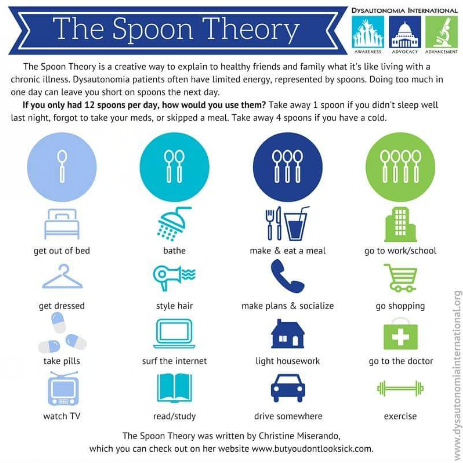
Photo credit: Dstudio Bcn via UnsplashWhat if every action you took - brushing your teeth, sending an email, cooking dinner - came with a price tag of energy you might not have? Spoon Theory helps us explain that invisible cost. Spoon theory is a physical demonstration of the mental and emotional energy a person has throughout their day. A healthy person starts the day with a very high number of spoons, while a chronically ill person gets a lower number to start their day. Each task takes a certain number of spoons depending on the task's complexity. How many spoons someone with chronic illness starts the day with and how much each activity costs can vary wildly day to day or even throughout the day. This makes it hard to plan and budget spoons for future tasks.
People living with chronic illnesses or disabilities may have the same amount of physical or mental tasks as someone who is not chronically ill or disabled, but those tasks may take more out of them. Sometimes it isn’t even just the physical task; it’s the mental load of the task that adds to how draining the activity might be. For some, just thinking about how you’re going to use your limited amount of energy (spoons) throughout the day is exhausting. Thinking about these tasks, prioritizing them, and choosing how and when to execute them can take a spoon away from your ever-diminishing pile of finite energetic cutlery.
Sometimes just a single task can take all of your spoons for the day. Because chronic illness and disability symptoms can vary from day to day, for example, a high pain day or a low pain day, sometimes an action that only took 1 spoon yesterday may take half your allotted spoons today.
So what happens if you run out of spoons for the day before the day is over? You might feel like you have absolutely no energy to do anything else. But life keeps going so inevitably, you borrow from the next day, kind of like an energetic division equation. However, this means you spend the next day in a deficit of these spoons, leading you to have less for that day. This can start a dangerous snowball effect that means that each day you just get less and less until one day you wake up with no spoons at all. When that happens, it’s called burnout.
Burnout can manifest in many different ways for many different reasons, but it means the same thing: exhaustion. Bone-deep, mind-numbing exhaustion that results from too much emotional, physical, or mental fatigue.
People who use the spoon theory in their day-to-day life and conversations about how their energy gets used are called “spoonies”. People find community in others who not only know of their energy struggles, but also the burden of needing to advocate for their energy needs in the first place.
As someone who is a spoonie, I can say that what I wish people understood about spoon theory is that for us, energy is finite. For someone without chronic illness, when you get tired after a task or work a long, exhausting day, it’s not the exact same as someone might experience with chronic illness. If your favorite band was coming to town and they were giving out free tickets, someone without chronic illness might be able to push through and do those things that they deeply wanted because the energy is there. For us, that is not the case. So the next time someone talks about being a spoonie, maybe have an open ear, open mind, and open heart, that our experiences are different and one does not negate the other’s experience.
“The concept of the Spoon Theory was first sparked in a college diner, where Christine Miserandino shared a meal with her friend. When her friend inquired about what it was like to live with a chronic medical condition, Christine grabbed all the spoons nearby and handed them to her.
She told her friend—’most people wake up with an endless supply of spoons, but here, for this experiment, you have 12.’ She asked her friend to walk her through her day. For each activity (waking up, showering, getting dressed), Christine took a spoon away.
Christine used this metaphor to explain that when she wakes up, she has a limited number of spoons. She must be meticulous about every choice she makes. Living with a chronic illness means she must always be aware of how much energy she had and what activities she would ‘spend her spoons’ on any given day.
Christine has since used this theory in the context of disability advocacy, and it has become a powerful metaphor for explaining how people with chronic illness, fatigue, or a disability must be acutely aware of their energy units.”
Written by: Grace Mintun
About the author description: Editor in chief and Creative Director at Necessary Behavior
Tags: Spoon Theory, Spoonies, Chronic Illness
Check out our social media for more resources:
Additional Reading



Sources
https://neurodivergentinsights.com/the-neurodivergent-spoon-drawer-spoon-theory-for-adhders-and-autists/?srsltid=AfmBOorpm4ExuHF8UZD73IXxC1j6HlvhILxmLnJgxBn5pI1R8SOUfZoj
https://www.instagram.com/p/DPO28KeD6UW/
https://www.drfanaee.com/blog/what-is-spoon-theory#:~:text=Summary,load%20required%20to%20complete%20tasks.
https://www.thebraincharity.org.uk/whats-spoon-theory/#:~:text=What%20happens%20when%20you%20run,Published:%2018%20July%202021
https://www.webmd.com/multiple-sclerosis/features/spoon-theory
https://www.psychologytoday.com/us/blog/full-catastrophe-parenting/202403/what-is-spoon-theory-and-why-is-it-important
https://www.webmd.com/mental-health/burnout-symptoms-signs
https://www.webmd.com/multiple-sclerosis/features/spoon-theory
Leave a comment