
Understanding the Difference Between Sex and Gender
Written By: Nury Chavez
Date: August 29th, 2025


Photo credit: Serenity Mitchell via UnsplashTo this day, many people seem to confuse and conflate sex and gender, often using them interchangeably; but these two things are not the same. Yet, even official government entities and documents don’t get it right. How many times have you seen “select your sex,” but the options are “man; woman; prefer not to answer?” Or there’s “what is your gender; female, male, or non-binary?” There’ve been some mix-ups, so let’s try to clear them up.
The short explanation is this: sex refers to a person’s biological make up, whereas gender refers to a person’s self-representation, which is “influenced by social, cultural, and personal experience.”
Still, I can see why there may be some confusion, and given that sex and gender have long been categories to differentiate people and affect their rights and quality of life, it’s important to really understand these concepts.
What is sex?
The Institute of Medicine (IOM), established in 1970, “is an independent, nonprofit organization that works outside of government to provide unbiased and authoritative advice to decision makers and the public.” And, in 2001, a committee convened by IOM concluded that there are major differences in the biology of males and females, and that to better understand them, scientists should make clear distinctions between and among sex and gender. They offered this working definition:
“In the study of human subjects, the term sex should be used as a classification, generally as male or female, according to the reproductive organs and functions that derive from the chromosomal complement [generally XX for female and XY for male].”
It’s important to note that it was understood that this definition–like other things–could and likely would evolve as we learned more. Indeed, that’s what has happened and the definition has come to encompass more specific physical and biological distinctions, such as hormone levels, breast development, voice pitch, and hair growth.
Sex is typically assigned at birth, most often based on the appearance of a newborn’s genitalia. If it looks like a newborn has a penis, they are classified as male; if it looks like they have a vagina, they are deemed female. But, the appearance of genitalia is not always enough to determine sex.
We have learned of a third category when it comes to biological sex: intersex. It’s estimated that 1% to 2% of the population “cannot be categorized as male or female across all traits. This could include people with ambiguous genitalia, people whose chromosomes are not XX or XY, or people whose external genitalia and internal reproductive organs do not align.” Often, people are unaware of these biological differences, sometimes learning about them at puberty or as adults having fertility issues.
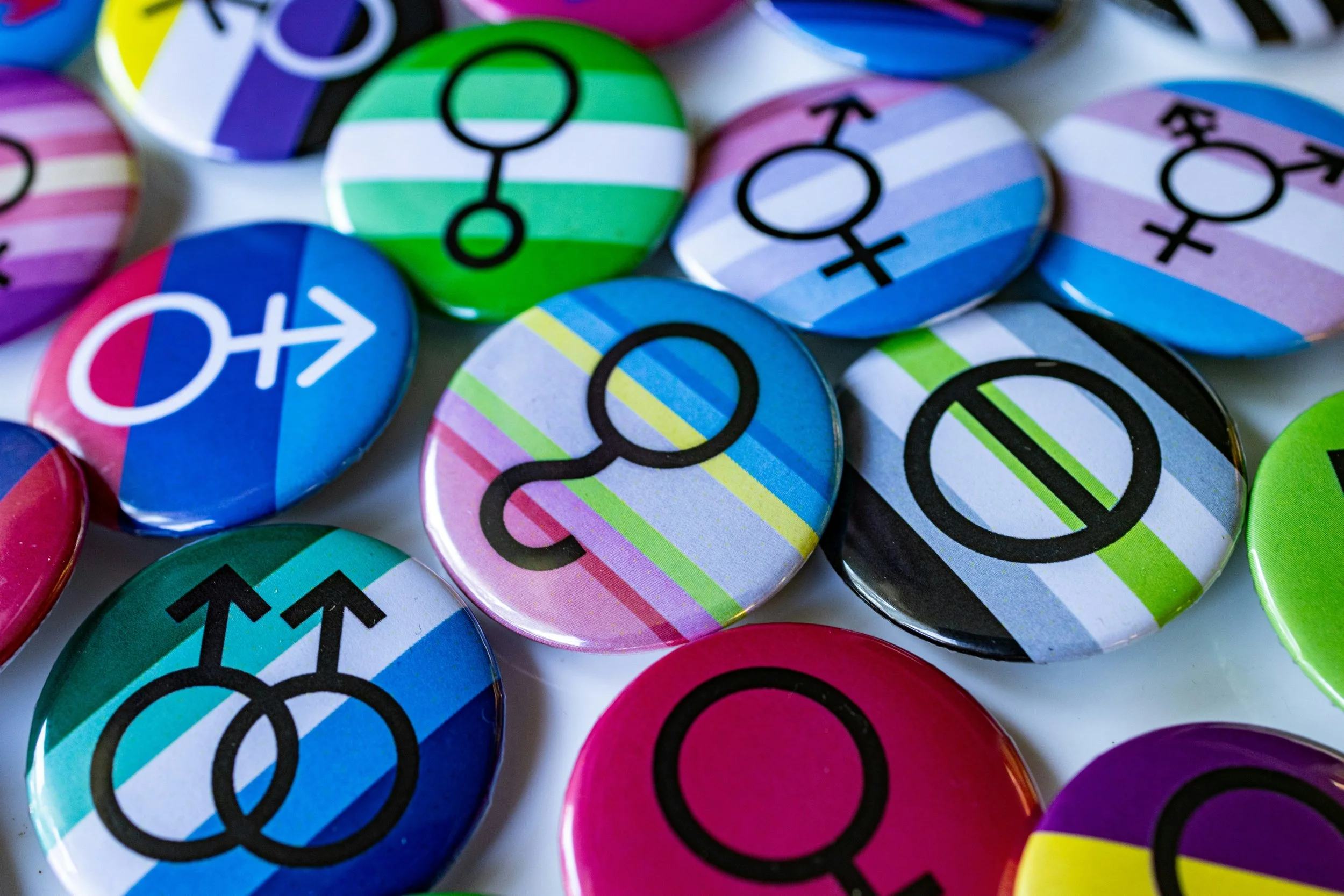
Photo credit: Marek Studzinski via UnsplashWhat is gender?
It gets a little trickier with gender.
But, let’s go back to what IOM originally suggested; “In the study of human subjects, the term gender should be used to refer to a person's self-representation as male or female, or how that person is responded to by social institutions on the basis of the individual's gender presentation.”
We’ve come to expand on that working definition by acknowledging that gender is a socially constructed classification based on roles, behaviors, and expectations that have come to be associated with and ascribed to females or males. So, to differentiate males and females–because humans love to compartmentalize things to create structure and order–people developed ideas about what it takes to be considered a part of each group. The concept of gender emerged as an informal way to identify, understand, and, arguably, to manage the two biological sexes that people were aware of.
A major culprit of the mixup between sex and gender comes from the way the concepts are connected. Sex is a category determined by biology, which labels someone as female, male, or intersex. Gender is a category that is culturally developed and understood to be descriptive of what a female- or male-appearing person may or should look and behave like in society. Traditionally, females who conform to those cultural ideas are socially labeled girls and women, and the males are referred to as boys and men.
Now, as people’s understanding of gender continues to evolve so have the categories, which have expanded to include other concepts, such as transgender, nonbinary, and genderfluid. On that note, it’s important to point out that gender–like most concepts in society–is fluid; ideas, definitions, and beliefs are constantly changing because people’s thoughts, behaviors, and patterns fluctuate and evolve. So, gender is also relative because it depends on how the social ideas related to it are perceived and represented by individuals.
A few things worth doubling down on so far; gender is based on self-representation; sex does not determine gender, and vice versa; gender is a social construct.
A sidebar on social constructs
Another key ingredient that adds to the confusion is the notion that gender is a social construct, which refers to a concept that exists as a result of human interaction around it and a consensus that the thing exists. In sociology, the theory of knowledge known as social constructionism “examines how individuals develop their knowledge and understanding of the world” through social processes and interactions. In other words, people agree–to different extents–on an idea and, after some time, they start to perceive it as an objective “truth” until “finally, in the last stage, the idea becomes ‘internalized’ in the consciousness of the society, and future generations more or less take the idea for granted as an objective truth, as the idea already exists in the world they were born into.”
The tricky part is that these socially constructed concepts tend to derive from (over)generalizations that can lead to limiting expectations and stereotypes. For example, the assumption that females are more adept at caretaking because they carry and give birth to offspring has led to a cultural association with female-appearing people having a natural, strong maternal instinct. In turn, this places an expectation for female-appearing people to display nurturing by being primary caregivers and homemakers in order to be considered as fulfilling their socially expected roles as “women.”
Money is another example of a social construct that’s a little easier to make sense of. Money has no real inherent value, in essence it is a piece of paper. But humans have agreed to place a monetary value on said pieces of paper. The concept of money exists and is upheld because people in society are in some consensus about its existence, appearance, and what it represents. And, even the concept of money has and continues to change, with cryptocurrency as the latest evolution.
Why understanding the difference matters
It’s dangerous to assume that concepts in society–like sex and gender–are fixed or objective truths. There is extensive sociological research that says otherwise. For any concept you can think of there will always be people who have different ideas, perceptions or beliefs around it, but that’s normal and not inherently problematic. Problems arise when people persecute others to the point where discrimination and human rights violations occur just because they don’t have the same beliefs.
Difference is inevitable the same way that change is, so we should all be making room for them.
Written by: Nury Chavez
About the author: Nury is a writer and editor with an academic background in Sociology. She is fascinated with exploring and creating connections among people and the world around us.
Tags: Sex Education, Gender, Social Constructs
Check out our social media for more resources:
Additional Reading



Sources:
https://medicine.yale.edu/news-article/what-do-we-mean-by-sex-and-gender/
https://www.ncbi.nlm.nih.gov/books/NBK219850/
https://www.simplypsychology.org/sex-gender.html
https://www.webmd.com/sex/what-is-intersex
https://psychcentral.com/health/compartmentalize
https://www.verywellmind.com/definition-of-social-construct-1448922#:~:text=A%20social%20construct%20can%20include,to%20interact%20with%20the%20world
https://www.simplypsychology.org/social-constructionism.html
Leave a comment