
A Decade of Same-Sex Marriage and the Path It Took to Get There
Written by: Baylie Dell
June 23, 2025
On June 26, 2015, the United States of America legalized same-sex marriage. All individuals of all sexes, genders, races, sexualities, and religions came together in a celebration of the upliftment of this great victory. It brought hope to the hearts of all individuals, not just the LGBTQIA+ community. There was a hope for a greater and brighter world, a world where the government focused more on love and unity instead of hate and divisiveness. Even though the United States was not the first country to legalize gay marriages - that distinction belonged to the Netherlands in 2000 - its global standing and power gave added importance to this event. By making such a move, as America did, it paved the way for other countries to do the same.
The battle for equal marriage in America did not begin in 2015. One of the most important and earliest court precedents was Loving v. Virginia, a Supreme Court case regarding interracial marriage in 1967. Richard Loving, a white man, and Mildred Loving, a Black woman, were convicted in 1959 of violating Virginia's Racial Integrity Act of 1924, legislation that prohibited interracial marriage. Judge Leon M. Bazile suspended their prison sentence on the condition that they would leave Virginia and never return there as a couple for 25 years. The Lovings, not eager to live in such inequality, appealed their case all the way to the U.S. Supreme Court. In a unanimous decision, the Court held Virginia's law invalid, as it offended the Equal Protection Clause of the Fourteenth Amendment. Virginia had argued that Black and white individuals were punished equally, but the Court properly interpreted that the law itself was discriminatory.
Loving v. Virginia set a precedent for future same-sex marriage arguments, as it held that the state cannot intervene in an individual's choice of whom they can be married to on discriminatory grounds. The path to same-sex marriage was not, however, without its imperfections.
It was in 1971 that the Minnesota Supreme Court got the case of Baker v. Nelson, the first to attempt to strike down prohibitions on same-sex marriage in America. The two plaintiffs were a gay couple who claimed that it was unconstitutional to prevent homosexuals from marrying. The Minnesota Supreme Court did not agree, and the U.S. Supreme Court refused to hear the appeal.
Twenty-two years passed, and then, in 1993, along came Baehr v. Lewin in Hawaii. Three gay couples here sued the denial of issuing them marriage licenses by the state as a violation of the Hawaii Constitution. The Hawaii Supreme Court sustained that the ban was discriminatory and sent the case back for more hearings. Although the case did not legalize same-sex marriage directly, it facilitated the national debate on same-sex marriage and led to the enactment of the Defense of Marriage Act (DOMA) of 1996 that legally domesticated the definition of marriage as between one woman and one man at the federal level.
Ten years later, a second milestone landmark was achieved in Goodridge v. Department of Public Health, a 2003 decision of the Massachusetts Supreme Judicial Court. The court ruled that gay couples could marry under the state constitution, and Massachusetts became the first U.S. state to legalize gay marriage. Thirty-six states followed suit over the course of the next dozen years through legislation, state court decisions, and voter referendums.
DOMA would later be put to the test in the 2013 United States v. Windsor case. Edith Windsor and Thea Spyer, two lesbians who were married, had been together for decades. When Spyer passed away in 2009, she left all of her estate to Windsor, only to have the federal estate tax exemption denied because their marriage was invalid according to DOMA. Windsor appealed this miscarriage of justice to the court, and the U.S. Supreme Court finally overturned Section 3 of DOMA, declaring that it did indeed violate the Fifth Amendment's equal protection guarantee. It was a landmark ruling, a watershed event that held that gay marriages had to be treated equally under federal law.
There was progress at the state level, but the issue was far from resolved nationally. All that changed in 2015 with Obergefell v. Hodges. The case grouped together a set of cases from across several states where same-sex couples were being refused marriage licenses or the recognition of their marriages. Lead plaintiff Jim Obergefell had married his husband, John Arthur, who was terminally ill with cancer. Their wedding in Maryland, while legal there, was not legal in their residential state of Ohio, and because of that, Obergefell could not be listed as the surviving spouse on Arthur's death certificate. The Supreme Court, in a 5-4 ruling, found that state bans on gay marriage were unconstitutional under the Due Process and Equal Protection Clauses of the Fourteenth Amendment.
Obergefell v. Hodges was a historic victory for marriage equality and the civil rights of LGBTQIA+ individuals in the United States of America. June 26th, the date when the court made its ruling, was made a day of jubilation by the LGBTQIA+ community. In fact, Queer couples have been getting married on the jubilation day as a symbol of freedom to marry the person they love, for which there had been such a hard struggle.
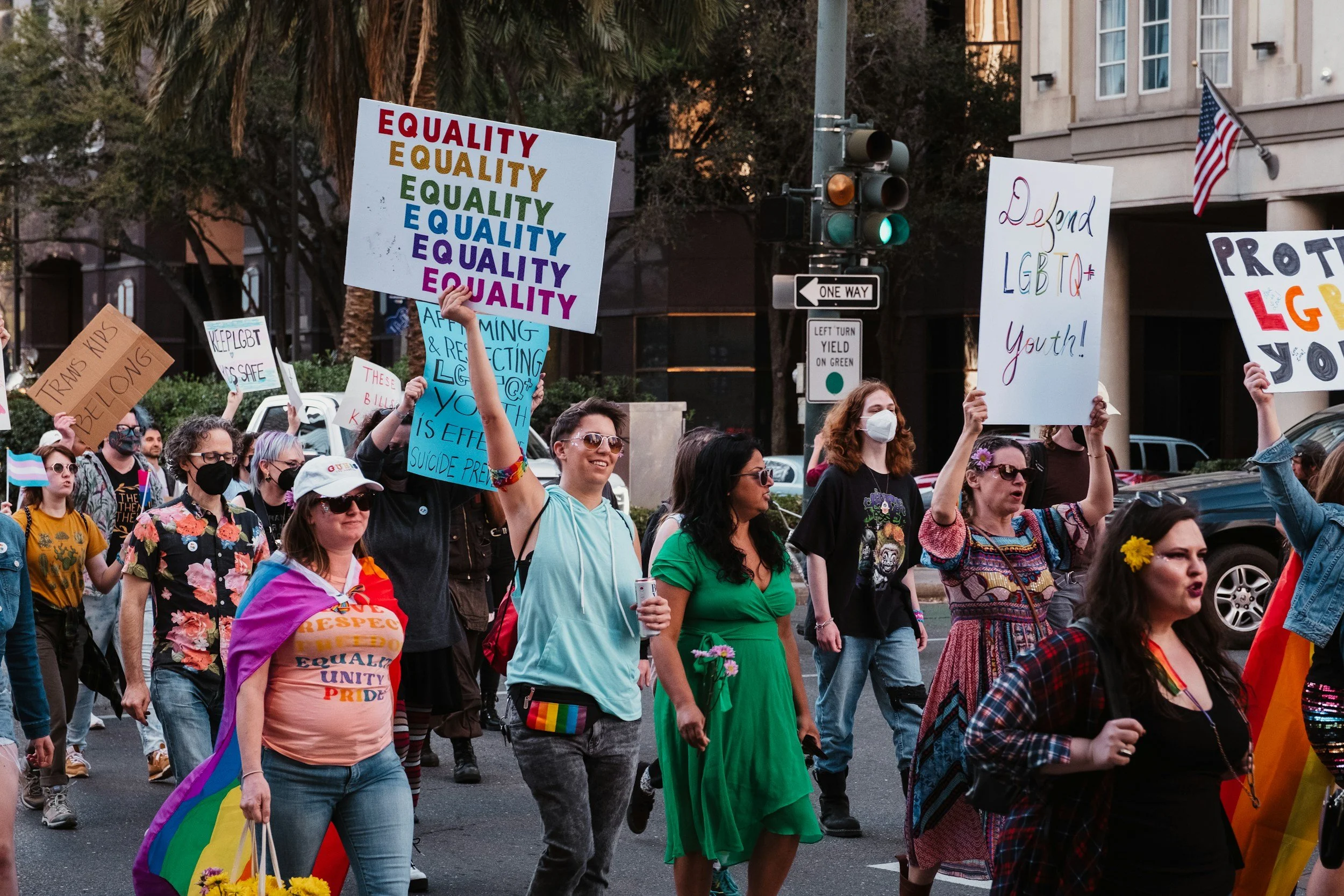
And yet nearly a decade later, the victory of that win rings hollow for so many. Despite gay marriage being legalized, queer individuals still experience systemic violence, discrimination, and marginalization. The past few years have seen waves of anti-LGBTQIA+ laws, including efforts to specifically target transgender individuals and children. States have introduced and passed bills that ban gender-affirming care, restrict access to bathrooms, and ban the teaching of queer identities in schools.
Socially, people are becoming increasingly hostile towards LGBTQIA+ folks. Homophobic and transphobic hate crimes are climbing, and a number of them result in murder. Online spaces that used to be safe for queer youth are now war zones filled with harassment and hate. In other spaces, Pride parades are being truncated or called off because of threats of violence, a chilling reminder that visibility has a cost. The groups have been highly advised for tourists to prepare and be safe (see Tips on How to Stay Safe While Protesting). In the meantime, the political climate in America has grown increasingly polarized, and right-wing politicians are using anti-LGBTQIA+ rhetoric to get people behind them. These attacks do not originate on the fringe alone but are being repeated in the mainstream media with the imprimatur of powerful public figures. Some legislators in some states have gone so far as to attempt to re-litigate the legacy of Obergefell v. Hodges, sounding alarms that marriage equality itself would be imperiled.
Elsewhere in the world, it is not easier. While some countries have followed the U.S. in legalizing same-sex marriage, some have gone in the opposite direction. Homosexuality is still illegal in some regions of Uganda, Russia, and other regions in the Middle East, and violators are punished with jail time to death. The LGBTQIA+ community across the world is fighting for basic human rights under perilous conditions in most instances.
Even in states where same-sex marriage is legalized, cultural acceptance remains a hurdle. Legal acceptance doesn't always translate to social equality. The majority of queer individuals still get rejected by their families, refused jobs, or suffer from mental illnesses due to social stigma. Suicides among LGBTQIA+ teenagers still remain alarmingly high, a reminder of how much farther we have to go.
We have to remember that progress is not a straight line. Rights gained can be questioned or rescinded. The LGBTQIA+ community never forgot this. The victory in 2015 was not a finish line but a marker on a very long journey. The battle for equality, dignity, and protection continues.
As we celebrate the tenth anniversary of marriage equality in the United States, we are compelled to honor those who have fought for it for so long and give due acknowledgment to the work yet to be accomplished. Pride is not a party alone; it is also a protest, a reminder that queer people are not just entitled to tolerance but must be accorded joy, safety, and freedom.
More than ever, allies must step up. It is not enough to ally oneself in private; public action, education, and advocacy must be undertaken. Vote for politicians who fight for queer rights. Call out homophobia and transphobia in your communities. Defend queer artists, businesses, and activists. Listen to LGBTQIA+ voices, especially those most marginalized in the community—trans people, people of color, and those who live in poverty.
The legalization of same-sex marriage is a step in the right direction, but this is only the beginning of the path to a better world that revolves around love. We can only construct this world where love rules - now not just in courts of law, but also in schools, hospitals, workplaces, homes, and hearts - through continued struggle, solidarity, and resistance with and for LGBTQIA+ folks.
Written by: Baylie Dell
About The Author: Baylie (She/Her) is an editorial intern and recent graduate with a degree in English Literature. She loves reading works that have political and social importance.
Queer, Activism, Equality
Sources:
https://supreme.justia.com/cases/federal/us/388/1/
https://law.justia.com/cases/minnesota/supreme-court/1971/43009-1.html
https://legacy.lambdalegal.org/in-court/cases/baehr-v-miike https://law.justia.com/cases/massachusetts/supreme-court/volumes/440/440mass309.html
Additional Reading

Check out our social media for more resources:
Leave a comment