A Love Letter to She-Ra and the Princesses of Power
Written By: Jacqueline Salazar Romo
Date: January 21, 2026
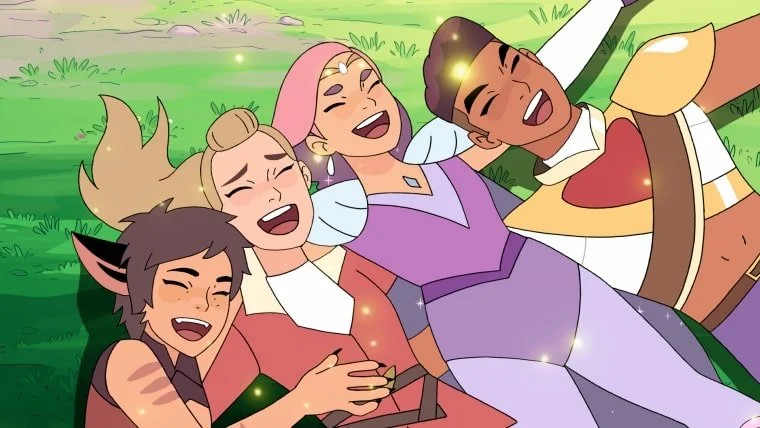
Screencap via DreamWorks, Netflix
*This article contains mild and minimal spoilers for She-Ra and the Princesses of Power (DreamWorks/Netflix, 2018-2020).
One month from when this article is published, my favorite show will disappear. The show that saved my sanity through 2020, that led me to find a community of amazing friends and my romantic partner, and that made me realize and accept my sexuality, is going to be permanently erased from Netflix with no certainty as to whether or not it will ever have another place to shine.
She-Ra and the Princesses of Power (SPOP, which I will use as shorthand) is an animated series that released a total of five seasons from November 2018 to June 2020. The series follows Adora, a soldier who deflects the militarized forces known as the Horde when she discovers a sword that transforms her into She-Ra, Princess of Power, a magical entity who is a remnant conduit to the arcane magic of an extinct people. Together with her newfound friends, known as the Princess Alliance, she seeks to defeat the villainous Horde and restore the balance and magic of the planet Etheria, as well as to learn more about her own enigmatic past. While presented as a children’s show, SPOP delves into surprisingly mature themes, especially in its later seasons, and its episodic villain-of-the-week style of storytelling evolves into a more nuanced plot that deals with the cost of war, impostor syndrome and belonging, confronting the cycle of abuse, allusions to religious indoctrination, and even the violence and evil of colonization.
If the title sounds at all familiar, you may recognize the titular character from her original source material: Filmation’s She-Ra: Princess of Power, produced from Mattel’s Masters of the Universe toy line back in the 1980s. That toy line may bring to mind the He-Man action figures, which depict Prince Adam, a young man from the mystical planet of Eternia who wields a Sword of Power that (you guessed it) magically transforms him into the powerful He-Man. Well, Adora/She-Ra was ideated to be He-Man’s twin sister, originated solely out of corporate interest to be the female complement to his toy line with the hopes of attracting young girls. With a copy-paste storyline and silly, whimsical antics, the 80s heroine was limited to being one-note, promotional content to sell toys. That is, until 2018.
I am no stranger to complaining about recent adaptations and reboots. In the past, I’ve been cynical and wary, even saying that I’ve found most of these derivations to be wholly unnecessary at best, or cash-grabby plagues to the essence of the original work at worst. But where many of these “remakes” seem to fail, SPOP manages to thrive. The series doesn’t just borrow from the original, but reinvents the source material in a way that captures the magic and fun of the 80s version while bringing something entirely new and beautiful to these characters. I could talk about the improvements to the original series all day, but to make it brief and as spoiler-free as possible, SPOP works to dismantle the Magical Girl and “Chosen One” tropes, teaching viewers to break the cycle and learn to choose themselves.
This show is also proudly, unapologetically, monumentally queer.
The reboot was co-created and pitched by none other than ND Stevenson, renowned comic artist and author of works that include Lumberjanes, Nimona (which was eventually adapted into an animated film by studio Annapurna Pictures through Netflix, but not without its own battle for completion and distribution), and more recently, the fantasy adventure novel Scarlet Morning. Following the leaps of predecessors like The Legend of Korra and Steven Universe, SPOP boasts of fantastic LGBTQ+ representation, with most (if not all) of the characters being either explicitly queer or queer-coded. More importantly, SPOP’s entire storyline is intrinsically built upon the complex relationship between Adora and Catra, Adora’s best-friend-turned-enemy. Their arcs, both as individual characters and as a unit, are woven into the very fabric of the show—you cannot have one without the other. It’s the first time a children’s animated series features two romantically involved, explicitly lesbian protagonists. And given that, it makes its upcoming removal from Netflix feel all the more intentional and cruel to LGBTQ+ youth.
SPOP is unfortunately not the first animated Netflix Original to be removed from the platform, nor will it be the last. Previously, Voltron: Legendary Defender (DreamWorks/Netflix, 2016-2018) was scrubbed after the producing companies’ distribution rights expired, and Kipo and the Age of Wonderbeasts (DreamWorks/Netflix, 2020) will also be removed, presumably for the same reason. While plenty of media leave Netflix all the time and then may return in a cyclical fashion, shows like the aforementioned often do not come back to the platform due to complicated licensing and proprietary troubles that come with a collaboration between multiple studios and companies (in the case of SPOP, intellectual property rights are even muddier since Mattel, on top of Netflix and DreamWorks, is also involved). Moreover, something else these shows have in common (aside from their overlaps in terms of distributors and producers) is their LGBTQ+ representation—with the Voltron fandom having hugely popular ship Klance; Kipo featuring supporting character Benson, an openly gay teenager; and SPOP being, well, SPOP. While it may not mean these shows will be guaranteed to become lost media (the hopes are that another streaming service will choose to buy the rights to air them), it is a major loss for the creators and teams behind these shows. Not only do these works end up losing visibility through the erasure from a mainstream streaming platform, but it feels especially devastating to lose family-friendly, queer-centered stories at a time when our narratives and livelihoods are already being so heavily censored and erased.
I first encountered SPOP shortly after its final season had just aired. While blearily scrolling through my Twitter timeline at 2am, a trending three-minute clip spoiling a major part of the ending caught my eye (if you know, you know). That innocent little taste of the finale compelled me so much that I started watching SPOP and became wholeheartedly obsessed. I could have never anticipated how much that show would come to mean to me, especially seeing it at a time in my life in which I was wondering if I was just confused, wondering if I even mattered. I bonded with others by sharing fanart and thinkpieces, and then I met someone who became more than just a friend—going from talking about fictional characters to getting measurements for engagement rings. None of this would ever have happened if I had not been overwhelmed by college finals, by my life as a closeted lesbian in denial, if not for doomscrolling that fateful day in search of something to ground me, some kind of sign that things would somehow be okay.
While SPOP is not without flaws, it’s a show made with love, about love. Seeing characters that I shared something with, even something small, being celebrated and loved despite their struggles and their traumas, gave me something to look forward to and made me feel seen in spite of the current hateful sentiments against our community. It gave me hope.
This is not the article I wanted to write about the show, but hopefully it may be one of the works that helps keep the show and its legacy alive. It may seem entirely ridiculous to pay homage to a Y7-rated kids’ series, especially coming from someone in their mid-20s who should have way more important things to worry about. But SPOP genuinely changed my life, and changed it for the better. So, if there’s any chance for you to binge-watch it before it’s too late, I hope you are able to find something special in it the way I did.
*She-Ra and the Princesses of Power is scheduled to be removed by February 21st, 2026.
Written by: Jacqueline Salazar Romo
About the author: Jacqueline (she/they) is an editorial staff member.
Tags: Animated Series, LGBTQ+ Representation, Queer Erasure
Check out our social media for more resources:
Additional Reading
Leave a comment