
What the Electronic Arts Buyout Could Mean for The Sims Players
Written by: Jacqueline Salazar Romo
Date: November 1, 2025

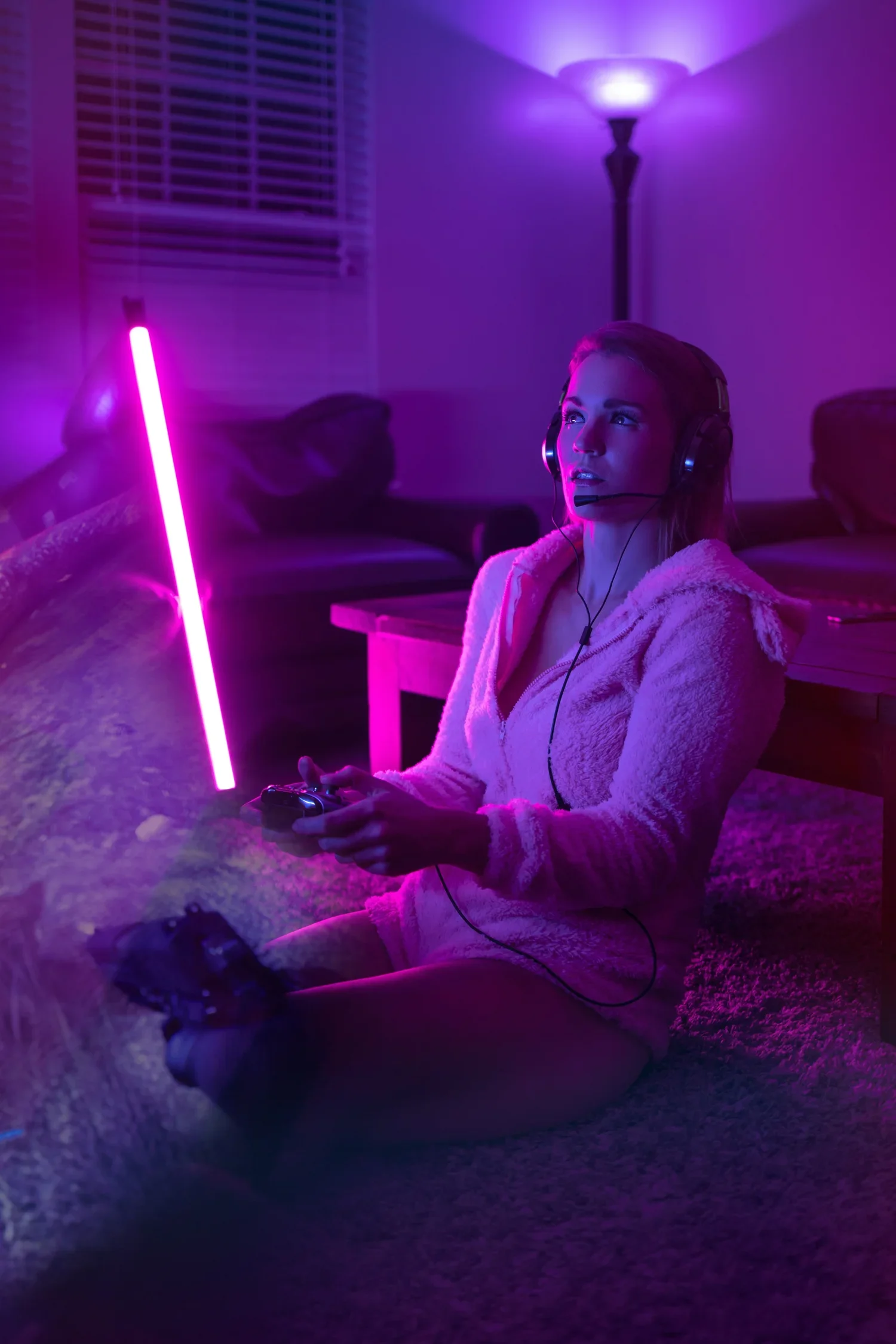
(Digital illustration by author)When asked to picture a gamer, a stereotypical image may come to mind. I can tell you what I used to associate with the word: Twitch streams featuring colorful LED light strips along the back wall, ergonomic chairs, and fancy setups with young men hunched over their desks playing first-person shooter games, passionately exchanging insults and slurs in a Call of Duty lobby. Reader, I wouldn’t ever describe myself as a gamer—growing up, my family didn’t have clunky consoles or DS cartridges, and it would be years into adulthood until I bought my first video game. But then I saw that Electronic Arts (EA) had made The Sims 4 base game free-to-play and decided to download it, thinking it would just be a casual way to destress during college finals. Yeah… that was over two thousand logged in-game hours ago.
What followed was an all-consuming and still ongoing fixation: finally revisiting the childhood wonders of life simulation gameplay as a creative, I became obsessed with playing out silly storylines, took a sudden interest in architecture to lay out floor plans, and had plenty of fun ruining my Sims’ lives, one deleted pool ladder and starving cowplant after the next. Even more exciting to me was the nightmarish amount of downloadable content (DLC) that took up all my storage and made my humble laptop dangerously overheat, humming loud enough to sound like an airplane was taking off from my lap. Needless to say, the interactive dollhouse that is The Sims franchise absolutely enchanted me, and even more so as developers and game designers have continually added new features and gameplay accessories that work to improve BIPOC and LGBTQ+ representation. Whether it was a few more textured hairstyles, body details like vitiligo and rosacea, or more Pride flags and gender/pronoun customization options, even the smallest detail meant the world to me as a queer Latine gamer whose childhood was always missing these types of inclusive options, as it does to so many of the game’s player base. So, when the news aired that EA is the prize jewel of the largest private equity-funded buyout in history, it really concerned this avid Sims player, and made me wonder what it will mean for the future of the game I love so much.
First, some context about EA. Founded in May 1982, EA has consistently made great advancements as a pioneer of the early home computer game industry. Aside from the Sims franchise, it boasts of widely known titles such as Mass Effect, Dragon Age, Plants vs. Zombies, and various Star Wars games, as well as popular games in their EA Sports division (ex: FC-FIFA, NASCAR, NBA Live, and UFC, among others). But the video game company is no stranger to controversy, having also had multiple low points in its tumultuous history (if it’s anything to go by, there’s an entire Wikipedia entry covering the various times EA has come under fire for anti-consumer practices, horrible employee treatment, exploitative company acquisitions, and other disputes). The latest controversy stems from the company unveiling their too-enthusiastic adoption of artificial intelligence, which only worsens once you consider the massive layoffs and union-busting endeavors EA has been undertaking. While EA hasn’t necessarily been losing profit, it’s not exactly in a favorable financial or reputational position either. So, what does this matter in relation to the recent acquisition?
As Daniel Stone explains for the Center for Economic and Policy Research, “Unlike standard acquisitions where a business purchases another company outright, leveraged buyouts are fueled by extreme levels of debt and require the acquired company’s cash flow to service the acquisition debt,” basically creating a model in which the company is forced to “[prioritize] short-term returns on investment to meet debt obligations at the expense of long-term growth.” For a company like EA, who has already been highly scrutinized by its customers for its predatory and cash-grabby transactional mechanics, this is very concerning, as it implies that the company will churn out pricey and unoriginal bloatware and seek to employ “more aggressive monetization schemes,” limiting creativity and experimentation for the sake of cheap, easy-to-make products. And this all would be happening not to really earn money, but to pay back debt… which leads us into talking about the buyout.
Approximately valued at a staggering $55 billion, this acquisition comes from an investor group that includes the Saudi Arabia Public Investment Fund (PIF), private equity giant Silver Lake (with its massive portfolio featuring names like Dell Technologies, WayMo, and Stripe), and Affinity Partners, an American investment firm founded by Jared Kushner (yes, that Kushner, Donald Trump’s son-in-law). And given the political leanings and backgrounds of the executives behind this buyout, the news has left long-time players worried about the potentially regressive impacts that new management will cause the game, to the point where some of the most well-known and beloved Sims streamers and content creators are risking their streaming careers by cutting partnership ties with the company after concerns over EA’s privatization.
To understand the possible impact of this buyout on The Sims, we have to start from the beginning—namely, the origin of the game that started it all. Creator Will Wright notoriously got the inspiration for the life-sim game after the 1991 Oakland firestorm burned down his home. From this tragedy sprung a desire to understand the existential ponderings of materialism and control, and as Wright’s team secured funding to create a game after his studio, Maxis, was acquired by Electronic Arts, they began ideating beyond the architectural simulator foundations of SimCity games. Instead of creating another building game, Maxis scaled down from the bird’s eye view of the big city, wanting to zoom in and explore domestic happenings, as well as the hijinks that take place in a close-knit neighborhood. And so, The Sims was born, releasing in February of 2000 and persisting into a franchise that has spanned twenty-five years. Of its unexpected success and longevity, senior producer Mike Duke told The Washington Post in 2020, “I’ve definitely heard rumors of, ‘The Sims’ was a game that was canceled and resurrected or, you know, often questioned. I think developing anything new, especially if it’s not [replicating] something else that’s already successful, there’s inherent risk. And it’s one of the hardest parts of innovation.” In short, entertainment executives had had little faith in investing in a domestic life simulation game, especially in a market that heavily centered bigger-budget, action-heavy gameplay. But boy, did it pay off, with the franchise being one of the bestselling sets of games of all time (and that’s not to mention its pop culture pizzazz).
More than just its sandbox charm and quirky characters, though, there’s another huge reason that The Sims has been as popular as it has: the passion and diversity of its players, thanks to the brand’s massive appeal to the LGBTQ+ community, especially. A game development mishap by programmer Patrick Barret made headlines; his insertion of coding allowing for same-sex relationships, unbeknownst to executives who had asked for the exclusion of said coding out of fear of backlash, led to an unplanned kiss between two female Sims in the background of a wedding scene being demoed at E3 1999. Since then, The Sims has especially attracted queer players for its groundbreaking leaps toward representation (for example, The Sims 3 allowing for same-sex marriages between Sims in 2009, six years before the same was granted in real life in the United States; and gender and sexual orientation options being among the most customizable they have ever been within and outside the franchise in The Sims 4). And while there’s still plenty of work to be done in terms of in-game BIPOC representation, Sims content creators (gamers who stream or create content based on the games) and modders (players who have enough technical know-how to create modifications that affect gameplay mechanics) fill the gaps in incredible ways.
While it’s had its controversies and shortcomings, the Sims franchise has a soft spot in millions of hearts, especially for marginalized and underrepresented communities that are now a growing fraction of the gaming industry’s consumers. 2023 data for The Sims 4 player demographics purports that only 21% of the game’s players identify as men, with 55% identifying as heterosexual. All of this to say, centered around The Sims is a diverse community that has appreciated finally feeling seen in a mainstream game. But now, our concern is whether what has made this franchise so special will be the first thing about it to be thrown out once EA’s acquisition finalizes.
English journalist and activist Laura Kate Dale, who has focused on writing about trans representation and accessibility within video games, says it perfectly in her own article about these news: “Company acquisitions are nothing new, but the more we see the video game industry consolidated under a small number of megacorporations, the harder it becomes to make ethical choices without having to move away from series that might be personally significant to you… Some pretty terrible people are soon going to own a key piece of queer culture, and even if they don’t pressure for the removal of queer content from The Sims, purchasing future games and content will financially benefit terrible people.” She summarizes my biggest fear regarding the EA buyout. Obviously, The Sims is not the sole video game franchise owned by EA, nor the only one that will be affected. But for a queer player who has found so much comfort and community through it, the news is overwhelmingly devastating.
We have yet to fully understand the changes that will take place once the buyout is finalized. But whether or not The Sims is able to pull through, one can only hope that the communities that will be most affected by these changes (players, employees, and the game industry as a whole) will be able to weather the storm.
Written by: Jacqueline Salazar Romo
About the author description: Jacqueline (she/they) is an editorial staff member who loves writing, whether creatively or within a non-fiction context, especially to explore current issues and personal interests.
Tags: Company Acquisitions, Electronic Arts, The Sims Franchise
Check out our social media for more resources:
Additional Reading

Sources:
https://www.wbur.org/onpoint/2025/10/29/ea-goes-private-what-it-means-for-the-future-of-gaming
https://www.videogameschronicle.com/news/ea-staff-are-struggling-with-managements-demands-to-use-ai-for-just-about-everything-report-claims/
https://futurism.com/artificial-intelligence/ea-attempts-use-ai-game-development-backfiring
https://www.gamedeveloper.com/business/industry-layoffs-are-seemingly-slowing-but-the-damage-has-already-been-done
https://www.cracked.com/article_39737_how-the-sims-became-queer-coded.html
https://apnews.com/article/ea-electronic-arts-video-game-silver-lake-pif-d17dc7dd3412a990d2c0a6758aaa6900
https://www.washingtonpost.com/video-games/2020/02/04/how-sims-navigated-20-years-change-become-one-most-successful-franchises-ever/
https://slate.com/technology/2025/10/the-sims-electronic-arts-games-jared-kushner-saudi-arabia.html
https://www.wired.com/story/sims-mods-black-creators-customization/
https://theconversation.com/how-the-sims-endless-customisation-fostered-one-of-gamings-most-diverse-player-communities-248686
https://www.ign.com/articles/the-sims-creators-quit-ea-partnerships-amid-buyout-concerns
https://www.ign.com/articles/ea-goes-private-in-55-billion-deal-with-pif-silver-lake-and-affinity-partners-andrew-wilson-to-remain-as-ceo
https://mobilesyrup.com/2024/04/10/microtransactions-arent-enough-ea-jacks-price-of-play-subscription/
https://pivot-to-ai.com/2025/10/27/electronic-arts-is-losing-income-and-crippled-by-debt-more-ai/
Leave a comment