
On Hozier’s Music (and Its Sociopolitical Commentary)
Written By: Jacqueline Salazar Romo
Date: September 24th, 2026
In Hozier (self-titled):
One of the most powerful lyricists of our time is often considered by most people to be a one-hit wonder. Even in spaces where he’s known for more than his most popular song, some of his fans seem to have a reductive and misguided perception of what his music is really about.
As most people were, I was first introduced to Hozier through his 2013 hit debut single, “Take Me to Church.” I am not kidding when I say this song completely changed my life and my worldview, especially as a deeply repressed and sheltered queer tween. And it changed his life, too: a devotional love song laden with religious imagery, the breathtaking ballad lifted the then-23-year-old struggling musician into notoriety. Andrew Hozier-Byrne recorded the song’s demo vocals in his parents’ attic, and those same vocals are the ones that peaked across global charts and earned him critical acclaim.
The music video for the song was also special: while the lyrics portray a female lover, the black-and-white visuals follow two gay men in a romantic relationship, and the persecution they face from a violent lynch mob. Much like the raw vocals of the song, its accompanying video was reportedly made on a small budget of €1,500, and the storyline was suggested by Hozier himself, who, critical of the Church’s historical institutional harm, wanted to bring attention to the plights faced by LGBTQ+ Russians. “The song is about loving somebody, and the video is about people who would undermine what it is to love somebody. I’d been following what was going on in Russia, where far-Right groups were doing these organised attacks, filming them and putting them on social media,” he told The Standard’s David Smyth, adding, “It’s important to remember that it can happen anywhere. It’s very easy for a society to fall into hatefulness, to scapegoat people, especially when times get tough.”
Since “Take Me To Church,” Hozier has had three albums: Hozier, his self-titled debut; his 2019 sophomore album Wasteland, Baby!, which builds on the imagery of “the death of all things / that are seen and unseen;” and Unreal Unearth, which was released in 2023 and follows the narrator through trials reminiscent of the Nine Circles of Hell in Dante’s Inferno. And while “Take Me to Church” is by far his most well-known track (aside from the recent unexpected hit about a dysfunctional couple, “Too Sweet,” widely misunderstood to be a love song), the Irish singer boasts of a collection of layered and outspoken, socially conscious music. While I could wax poetic about his entire discography, it is a disservice to his craft and lyricism not to acknowledge these politically overt songs, some of which I want to highlight below.


Unreleased songs:
“But The Wages”: The chorus line “It’s all going up but the wages” says it all: the narrator points out the injustices and inequalities of the world, how everything is “going up” (inflation disparities, rising living costs, climate change effects) and how all of these problems are building to a boiling point. It is followed by “And maybe it’s time;” a cynical invitation for the world as we know it to burn.
“Jackboot Jump”: This song was inspired by multiple protests throughout 2016-2019, as per Hozier’s own GENIUS annotations—in the first verse, the Dakota Access Pipeline protests against petroleum drilling at the Standing Rock Sioux Reservation; in the second, student-led protests in Moscow for democracy; and in the third, protests in Hong Kong opposing the Beijing government’s increasing regulations and laws against dissenters. The lines “All around the world / You’d think that things were looking rough / But the jackboot only jumps down / On people standing up” clue you in on what the “jackboot” truly is: a metaphor for the oppressive powers that seek to squander community organizing and collective freedoms.
In Unreal Unearth:

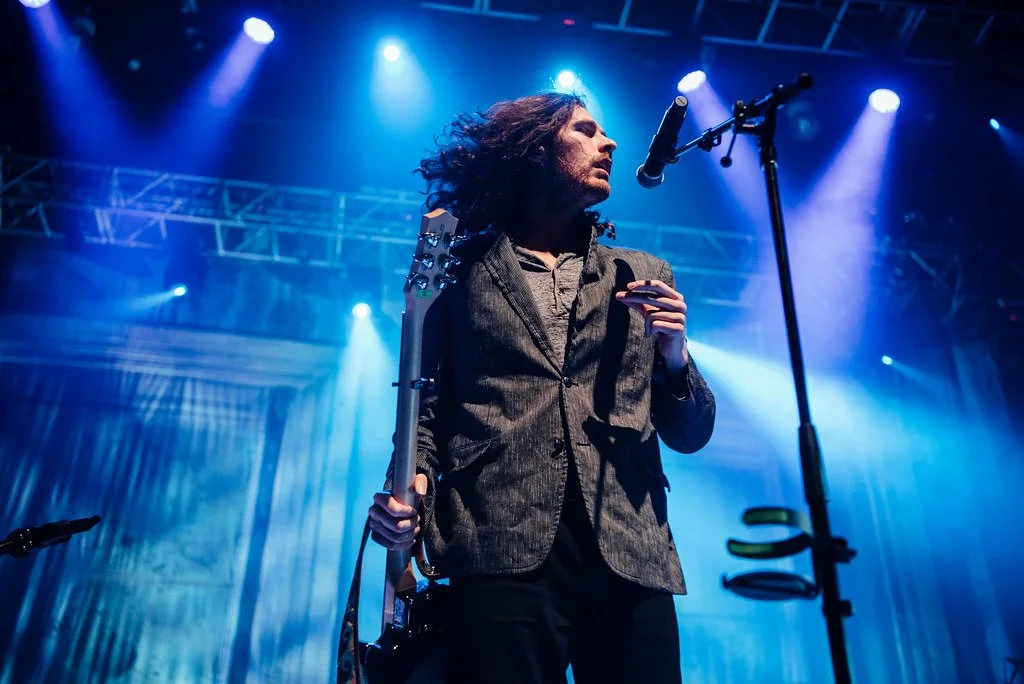
Hozier at House of Blues Boston. Image Cred: Knar Bedian, Flickr.
“Foreigner’s God”: In Hozier’s words for a track-by-track breakdown, this song is “[about] feeling alien in a culture, feeling distant from your own cultural values and [not] being able to express that.” Contextually, the song is likely referential to Ireland’s own fraught history with the Catholic Church. Some of the lyrics that stand out especially: “But still my heart is heavy / With the hate of some other man’s beliefs…” (a glance at how religious indoctrination through occupation can sow hatred and division); “All that I’ve been taught / And every word I’ve got / Is foreign to me” (the loss of identity and culture due to the forces of colonization); and the haunting chorus, “Screaming the name of a foreigner’s God / The purest expression of grief” (a mourning for what has been lost).
“Cherry Wine”: A devastating melody written from the perspective of a victim in an abusive relationship who stays with his partner despite the pain she inflicts upon him, exemplified best in the chorus verse: “The way she tells me I’m hers and she is mine / Open hand or closed fist would be fine / The blood is rare and sweet as cherry wine.” The music video inverts the roles, with actress Saoirse Ronan as the abused partner. The song’s download proceeds were donated to international charity organizations for victims of domestic abuse.
In Wasteland, Baby!:
“Nina Cried Power”: Featuring legendary gospel singer and civil rights activist Mavis Staples, this song is the incredible opener for the album: a ballad that honors the legacy of activism through music, named after the High Priestess of Soul, Nina Simone. Not only does this song name-drop several musicians and advocates that have shaped our world, but the thesis of “Nina Cried Power” lies in its opening—“It’s not the waking, it’s the rising.” It is an invitation to rise and stand for something, to mobilize and “cry power” to a movement that matters.
“Be”: A love song of sorts, but exploratory of the sociopolitical turbulence that will bring about an apocalypse; in “Be,” Hozier’s narrator asks his lover to “Be as [they’ve] always been” despite the world falling apart around them, even if “the sea rises to meet [them].” A song that places immigration, inequality, and climate change as forces that will enact their vengeance on humanity: “When the man who gives the order / Is born next time ‘round on the boats sent back / When the bodies starvin’ at the border / Are on TV givin’ people the sack”—all of these “when”s represent the end of times to come.
“Eat Your Young”: Don’t let its playful beat deceive you; “Eat Your Young” is explicit and even graphic in its commentary on the human cost of war, and how the young are often the price of power, both through their exploitation and their indoctrination: “Come and get some / Skinning the children for a war drum / Putting food on the table selling bombs and guns / It’s quicker and easier to eat your young.”
“Butchered Tongue”: Hozier revisits some of the grief that he had explored in “Foreigner’s God” with this song, in which the narrator reflects on the language he has been separated from—this figurative “butchered tongue” whose history haunts his experiences. A poignant, heart-wrenching song referencing the Wexford Rebellion of 1798, in which British forces maimed and tortured Irish rebels. Ireland’s history of resistance encompasses fighting back against the stripping of Gaelic dignity and cultural identity, and this song is especially moving to hear as someone from a country whose language was also shaped and affected by colonization and displacement.
In Unreal Unearth: Unending (additional tracks):
“Nobody’s Soldier”: Caught being a cog in the machine, the narrator asserts himself in the chorus, refusing to contribute to the cycle of violence and war as a pawn of the system: “I don’t wanna choose between being a salesman or a soldier / Just let me look a little older, let me step a little bolder / Choose between being a butcher or a pauper / Honey I’m taking no orders, I’m gonna be nobody’s soldier.” The music video is also wonderfully full of haunting imagery symbolizing the impact of political oppression.
“Swan Upon Leda”: The song makes use of the Greek myth in which Zeus, disguising himself as a swan, makes advances on Leda, the Queen of Sparta. While many depictions of this tale portray Leda as a seductress on equal footing to the Greek god, Hozier’s lyrics reject this positioning, instead choosing to emphasize the inherent violence of this rape and sympathizing with Leda, the survivor. Of the origins of the song, Hozier tweeted: “Egyptian journalist and author Mona Eltahawy once referred to the global systems that control and endanger women as the world’s ‘oldest form of occupation’... The recent pushbacks against civil liberties and human rights respect no boundaries or borders, and like all acts of control, violence and indeed all forms of occupation, their legacies can be immeasurable in both the personal and political spheres.” The song especially alludes to the cruelty of occupation and reproductive injustices, as Roe v. Wade had just been overturned.
“Empire Now”: A song about empires, and how despite all their power, all empires crumble in due time (“Sun comin’ up on a dream come ‘round…” and “If [the world] falls / I would hold on for all it’s worth / The future’s so bright it’s burnin’”). The narrator also highlights the rebels and advocates who revolutionized the world and set the destruction of “empire” in motion: “Martyrs of our revolution / Their spinning caused the earth to shake / The problem brought its own solution / They power now the world we’ve made.”
Despite how often non-listeners and even some of his fans stereotype him as a mellow, "woodland" indie musician, Hozier’s lyrics can often be quite socio-politically resonant and relatable to the world we live in. As he often credits a lot of his soulful, deep sound to greats like Nina Simone and Chicago blues artists, acknowledging how these musical roots are intrinsically connected to factors such as race and class is so important to understanding where so much of his perspective and storytelling comes from. Art is inherently political, and Hozier’s songs and performances are often about so much more than surface-level tunes. It’s about time that the messaging in his music doesn’t get lost in translation.
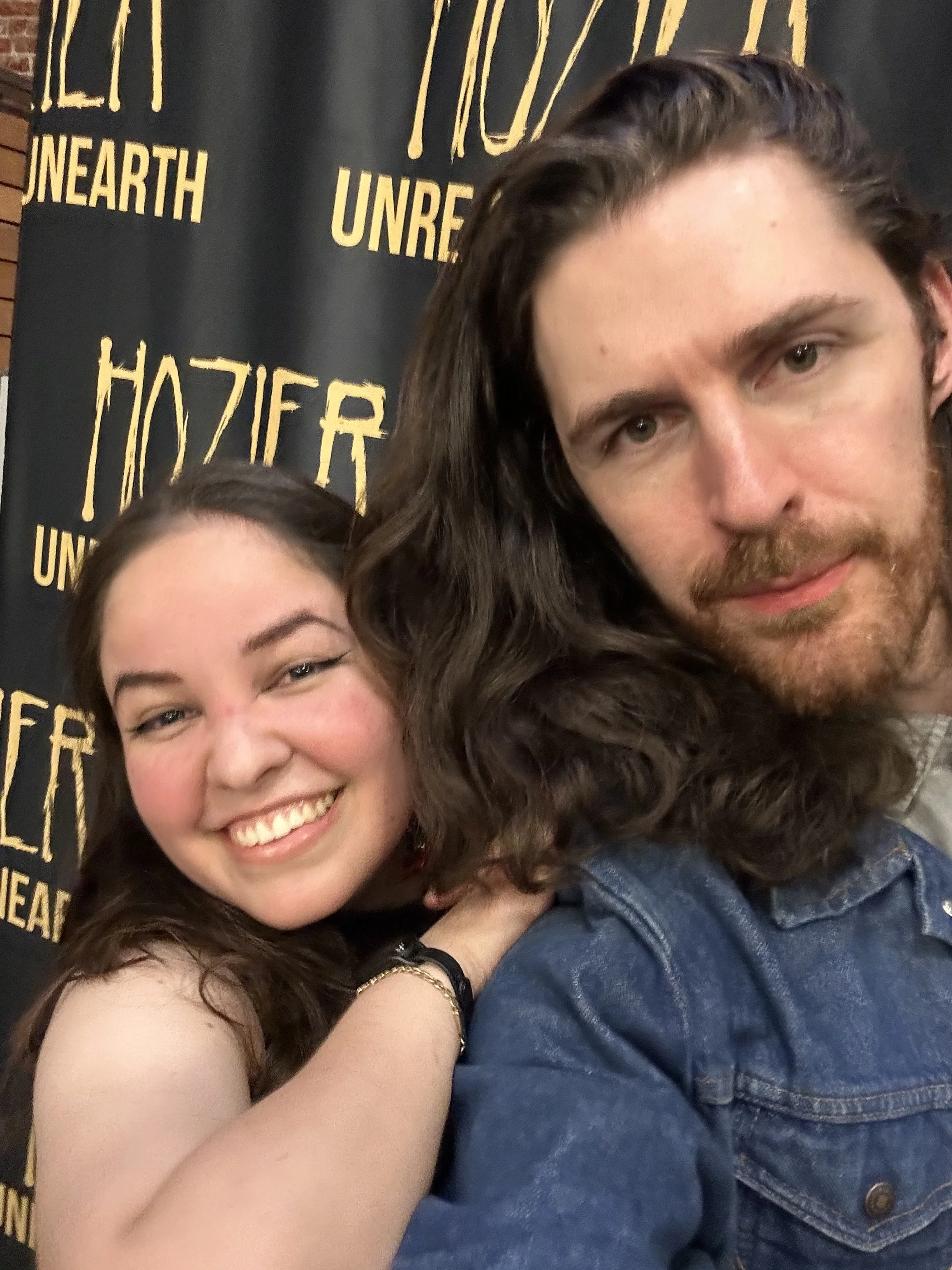
Author meet-and-greet selfie with Hozier :^) (2023)
Written by: Jacqueline Salazar Romo
About the Author: Jacqueline is an editorial staff member at NB who often explores the intersections of identity, belonging, and culture in relation to current events. Whenever she isn't writing, she enjoys art, fandom, and thinking too long about the past.
Activism Through Art, Lyric Analysis, Hozier (Musician)
Check out our social media for more resources:
Additional Reading

Sources:
https://www.irishexaminer.com/lifestyle/arid-20310955.html
https://www.youtube.com/watch?v=7cBgiLhoQo4
https://www.nme.com/news/music/hozier-2-1200750
https://www.cfr.org/backgrounders/hong-kong-freedoms-democracy-protests-china-crackdown
https://www.bbc.com/news/world-europe-49446736
https://ncheteach.org/resource/gaelic-resistance-two-nine-years-war-struggles-in-ireland/
https://www.nam.ac.uk/explore/irish-rebellion-1798
https://genius.com/a/hozier-laments-the-oppression-of-women-on-new-song-swan-upon-leda
https://x.com/Hozier/status/1577051127144939520?s=20&t=dR41asw7yO37TIPkL37tJw
https://reproductiverights.org/resources/roe-v-wade/
https://www.britannica.com/topic/Leda-and-the-Swan

Leave a comment