
Is the Generative AI Bubble About to Pop? On Sora’s Shutdown and Fruit Love Island
Written By: Nicole Snook
Date: April 6th, 2026
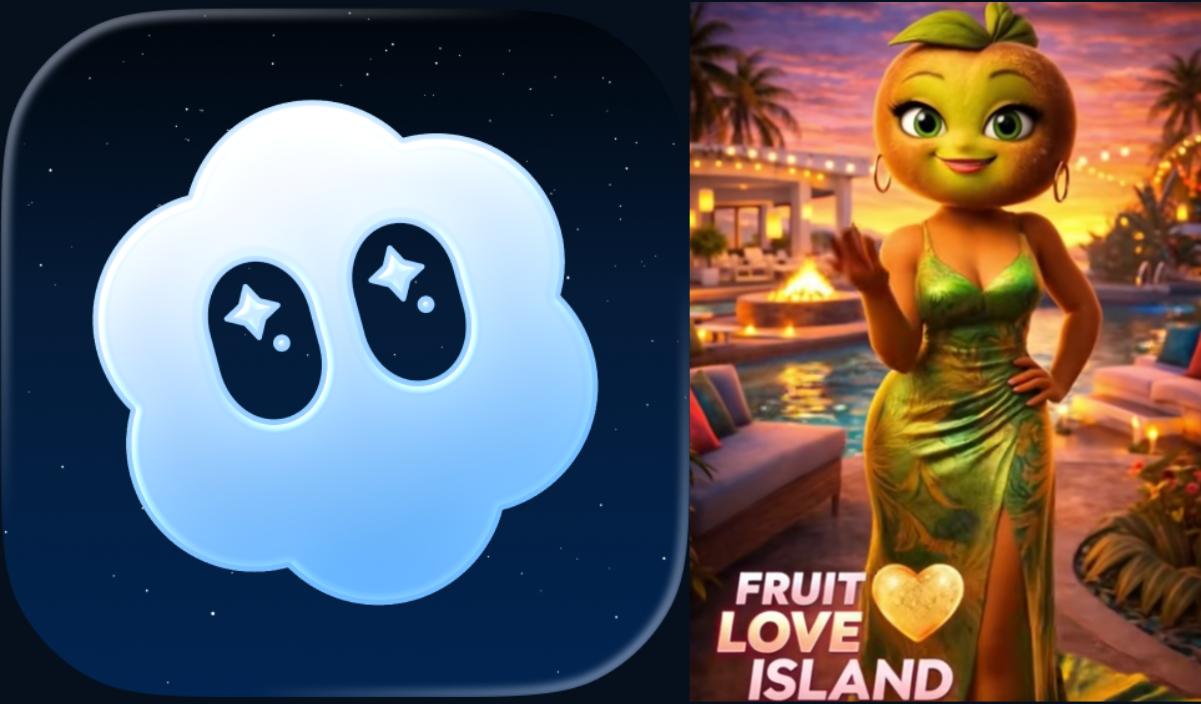
Sora App Icon on Left and Screenshot from Fruit Love Island Episode 1 on RightArtificial Intelligence (AI) is being forced down our throats constantly. While traveling through big cities, billboards for each company’s special AI are everywhere. Every website has its own AI helper built in, screaming at you from the corner of your screen to use them if you need help. Classmates and colleagues are praising AI for all it can do and write. Parents who once told us to “not trust everything on the internet” are now showing us videos of dogs singing the national anthem while on a skateboard. Tech companies are raving about AI’s potential. People on TikTok are tuning into AI episodes of Fruit Love Island, rooting for generative humanoid fruits to find “love.” AI feels completely inescapable, but not all hope is lost.
On March 24th, 2026, Sora, an OpenAI app that uses generative AI to turn text prompts into videos, announced it will be shutting down. The Sora app only launched at the end of September 2025, having a short lifespan of 5 months. Sora’s shut down ultimately led to Disney pulling out of a $1 billion contract with OpenAI. While this doesn’t mean Disney isn’t going to continue to seek out other investments in generative AI, it does show that there’s not as high of a demand for this type of content.
This is good news for creatives whose livelihoods are threatened by generative AI creating “art” in various mediums. Generative AI cannot create original thoughts. Instead, it compiles data and combines what it has found into a “new” photo, video, or piece of writing. This means that generative AI, including Sora, is not creating art; it’s actually stealing from real artists. Since there is a lack of laws surrounding generative AI using other people’s content and likeliness, there have been virtually no consequences for AI companies infringing on copyright laws. Hopefully Sora’s shut down will send a message to Disney and other companies choosing to use AI over real artists that generative AI is not as lucrative as they once thought.
Sora shutting down is also a win for the environment, as data centers, which are used by generative AI, use massive amounts of water each year. It is predicted that AI data centers will use a total of 68 billion gallons of water by 2028. As more generative AI companies shut down, the less need there will be for data centers.
With all of that being said, companies are still laying off their employees because of AI’s potential. Even with companies shifting to an “AI-first model,” most are not seeing an improvement in their revenue. Researchers from MIT have recently found that 95 percent of attempts of businesses incorporating generative AI into their companies are failing, with only 5 percent seeing higher revenue. If this trend continues, it may lead to the AI bubble popping as more businesses see a net loss from incorporating generative AI into their work.
Even though this is all great news for artists who are having their work stolen by generative AI, there is still plenty of AI-slop content on the internet. On TikTok, Fruit Love Island has been immensely popular, with the account @ai.cinema021 gaining over 3 million followers and 300 million views in nine days. People are aware that this account is posting AI-slop, but are still choosing to watch each episode. One positive is that many users are criticizing this content, with commenters writing “This isn’t even entertaining” and “how to dislike a video.” While it may be tempting to tune in to the drama, it’s important to remember that content like this is contributing to AI water usage and the theft of real art.
Rather than using generative AI to steal art and create unsettling content, we should be using it in ways that will actually benefit humans. AI can be used for multiple different advancements in the medical field to help doctors better care for their patients. A recent study found that AI can help in cancer diagnosis and treatment by increasing medical imaging accuracy, detecting early signs of cancer, and creating specialized treatment plans for different patients. The AI techniques used in medical research are machine learning and deep learning, which use algorithms to identify patterns and make predictions. This is different from the generative AI used to make videos and photos from other people’s works. The Imperial College London and Edinburgh University have developed an AI software that can scan for brain cancer. This is where efforts should be put in developing AI, not in generating drama between human-like fruits.
The reality is that AI isn’t going anywhere despite its ramifications on the environment and its stealing of human art. If we as a society put more of an emphasis on using AI for good, such as in advancing scientific research and assisting in the medical field, we can encourage tech companies to shift their focuses away from generative AI. If we continue to be outspoken about our hatred for AI-slop, more apps and companies like Sora will continue to shut down. We can only hope that the AI bubble will pop soon, for artists’ and the environment's sake.
Written by: Nicole Snook
About the author description: Nicole Snook is an editorial staff member and a student working towards her English degree with a minor in professional writing. She enjoys reading, horse back riding, and gaming.
Open AI, Generative AI, AI Bubble
Check out our social media for more resources:
Additional Reading
Leave a comment