Harry Potter and the Atrocious Author: JK Rowling and Why “Death of the Author” is Not a Good Excuse
Written By: Jacqueline Salazar Romo
Date: June 10th, 2026
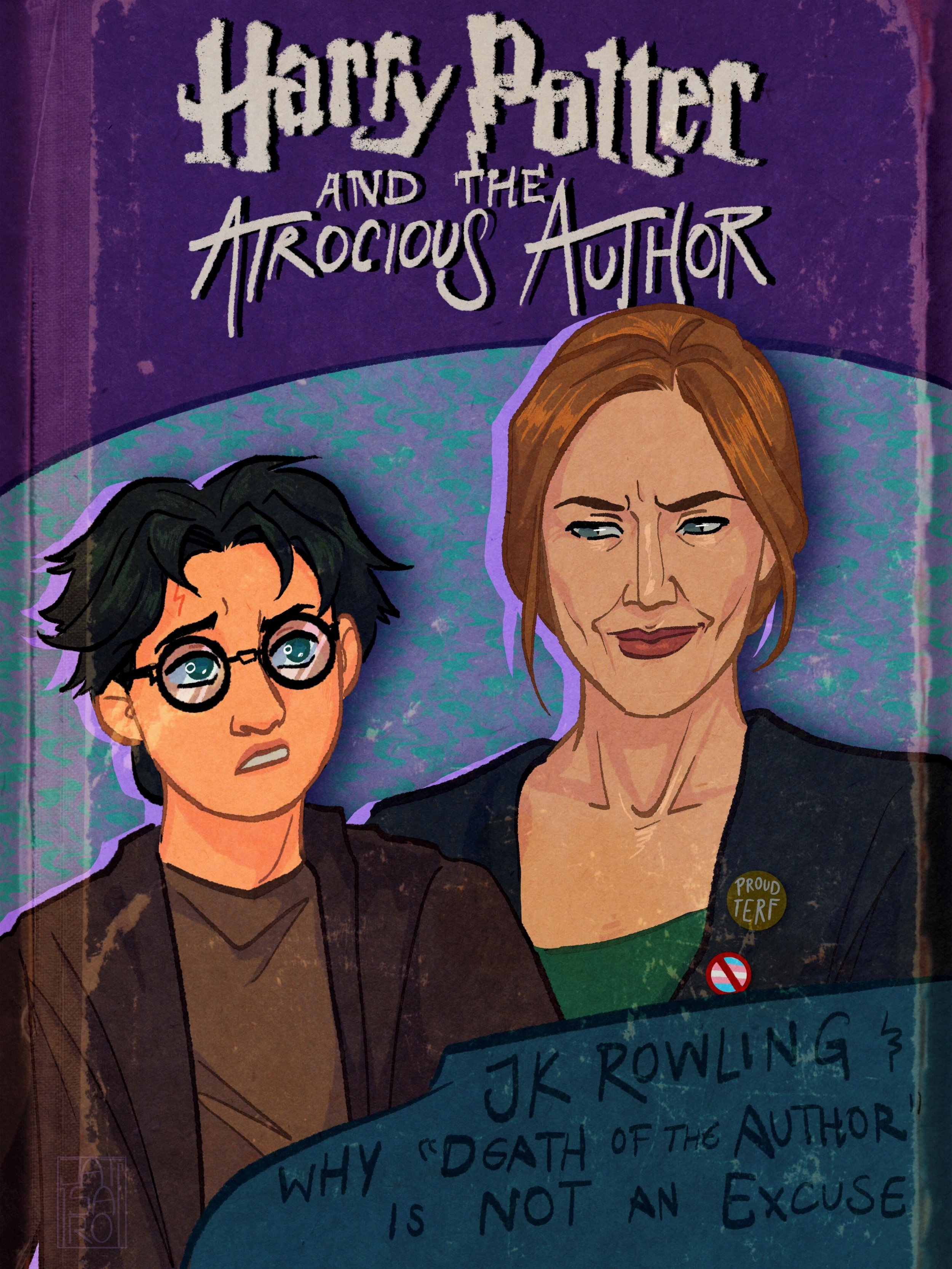
(Digital illustration by author)Nearly thirty years ago, and after rejections from a dozen publishers, JK Rowling published a middle-grade fantasy novel about an orphan with round glasses and a distinctive lightning-bolt scar who discovers he is a wizard and gets transported to a magical school. This story about a boy named Harry Potter was met with explosive acclaim, and soon evolved into a seven-part saga with various spinoffs and a multimillion-dollar movie franchise. Needless to say, Rowling has greatly benefited from the financial and cultural success of the books (1997-2007) and the film series based on them (2001-2011), which is the fourth highest-grossing film franchise of all timeto date. As recently as 2025, Forbes estimated that Rowling’s net worth sits at around $1.2 billion, and that she earns around $80 million per year thanks to Potterverse sales (everything from her original books and their subsequent film/television adaptations, to monetization from products like video games, a screenplay, a musical, merchandise, and theme park features, among others). Moreover, “The Boy Who Lived” is being revived once more, as it was announced by The Hollywood Reporter that a live-action TV series was in early development at HBO Max in early 2021; the first season is reportedly scheduled to premiere on the streaming service on Christmas 2026. But after three decades of Harry Potter, its author has chosen to stay relevant through controversial means, all of which only deteriorate the love many have for her work.
As far as middle-grade chapter books go, Harry Potter is not exactly exceptional in terms of storytelling quality, nor is it groundbreaking in its tropes or particular characters—after all, devices like the Hero’s Journey and the “Chosen One” are timeless staples across genres and literary periods. A comment from literary giant Ursula Le Guin for The Guardian often comes to mind: “I have no great opinion of [JK Rowling’s writing style]. When so many adult critics were carrying on about the ‘incredible originality’ of the first Harry Potter book, I read it to find out what the fuss was about, and remained somewhat puzzled; it seemed a lively kid’s fantasy crossed with a ‘school novel’, good fare for its age group, but stylistically ordinary, imaginatively derivative, and ethically rather mean-spirited.” Labeling Rowling’s work as “stylistically ordinary” and “imaginatively derivative” feels especially pointed when you learn that Rowling is said to have drawn uncredited inspiration from high-fantasy greats like Tolkien’s Lord of the Rings and Le Guin’s own Earthsea Cycle series (which similarly followed a young boy in a magic school, with its first book written in 1968, nearly thirty years prior to the publishing of the first Harry Potter book, Philosopher’s Stone). But when it comes to Le Guin calling the Harry Potter books “ethically rather mean-spirited,” there is little left to extrapolate from her quote for us to understand what she meant.
I can only offer up my own interpretation: while she may have intended to write an innocent coming-of-age saga, Rowling ended up imbuing the Wizarding World with her own biases and prejudices. I mean, really, an Asian character named Cho Chang and a Black wizard named Kingsley Shacklebolt? Not to mention the “gay Dumbledore” queerbaiting claims. Rowling declared the Hogwarts Headmaster to be gay in a tweet from October 2007, but unfortunately did little to nothing to meaningfully depict his sexuality within the actual text; that is, until the spinoff prequel film series Fantastic Beasts and Where to Find Them danced around the subject for three movies before they were indefinitely cancelled due to diminishing box office returns and multiple controversies. There has also been great debate around Rowling’s depiction of Goblins (which many say follows antisemitic caricatures of Jewish people being “hook-nosed” and money-hungry) and werewolves as a stand-in for HIV (which… could be a whole other article, thanks to the problematic conclusions that can be drawn from associating lycanthropy in the Potterverse to a stigmatized illness that harms primarily LGBTQ+ individuals, gay men in particular, but I’ll digress for now). Sure, a lot of these instances are chalked up to simply Rowling being unintentionally callous, or to her writing being “a product of its time.” But how many of these harmful stereotypes and tropes can be waved away before they become inexcusable?
All of this, and we haven’t even brought up the biggest elephant in the wizard’s room: Rowling’s now-infamous and ongoing contentiousness against the transgender community. Since “accidentally” liking a tweet referring to trans women as “men in dresses” back in March 2018, Rowling faced growing criticism as she continued to follow “self-professed transphobe[s]” and support vocally anti-trans people. But she did not face major backlash until June 2020, when she snarkily tweeted a response to an article about accessibility for menstrual products that used inclusive phrasing. Quoting the article’s wording of “people who menstruate,” she questioned: “I’m sure there used to be a word for those people. Someone help me out. Wumben? Wimpund? Woomud?” (implying that the word is “women”). Since then, she has only doubled down, attacking cisgender female athletes who are wrongfully accused of being “men in women’s sports,” publishing books about characters being persecuted for “gender-critical” views under her pseudonym Robert Galbraith (oh, the irony) and coyly attributing Trump’s 2024 election win to his anti-trans stances, among other controversies. But it doesn’t stop there. The author has also grown increasingly involved in legal affairs and politics in the U.K., more recently donating £70,000 to a Scottish anti-trans campaign seeking to cement the legal definition of the word “woman,” and making a cocky celebratory post on Twitter/X after the group’s success, as the U.K.’s Supreme Court ruled that the Equality Act “defines women as those born biologically female.”
Right about here is where the “let people enjoy things” crowd barges in, and the “Death of the Author” excuse magically bursts into view. If you are not familiar with the latter phrase, it originated from French literary theorist Roland Barthes’s 1967 article of the same name. In it, Barthes purports that the author of a work, as well as their intentions, should be considered an entirely separate entity from the writing they have produced, as the meaning of the text must be derived by the readers. In his words, “To assign an Author to a text is to impose a brake on it, to furnish it with a final signified, to close writing”—the author-audience relationship becomes merely transactional since the text will develop a life of its own, and readers should be allowed to interpret the writing without having to support the views of the person who wrote it.
It’s a similar concept to the “separate the art from the artist” call, which often stems from a desire to engage in and appreciate a work of art while setting aside the creator’s personal (and problematic) views. And while this is a valid approach to literary and artistic criticism, it is often conflated with an attitude of “I can enjoy media despite its problematic origins if you don’t remind me that the person behind it sucks,” which does much more harm than good. Whereas there are plenty of renowned creatives that have had controversial histories, there are ethical and thoughtful ways to engage with their work critically without supporting them financially—particularly posthumously, through second-hand means, once monetary proceeds no longer benefit the person directly, or once the work’s copyright expires, for instance. But it is disingenuous to claim the same for a franchise of Harry Potter’s magnitude, especially when the work in question is still contributing to the success of the person behind it, fueling their bigoted campaigns against an already vulnerable and highly demonized community.
Perhaps I am fortunate to not hold as deep an attachment to Harry Potter as so many of my Millennial/older Gen Z peers; this indifference toward the Wizarding World has allowed me a greater level of cynicism for Rowling that many emotionally invested Harry Potter fans cannot possess. But at the same time, I don’t blame them for finding its fantasy appealing. Who doesn’t want to root for the underdog, the neglected and undervalued little orphan who finds strength, family, and power through magic? It’s natural for the most marginalized and ostracized in our society to connect with Harry and to see their plights reflected in a boy who survived and thrived despite all odds. And it only makes sense for so many young LGBTQ+ readers who grew up with the Harry Potter books to resonate with the budding wizard. Harry only got to flourish into his true self once he was no longer limited by his upbringing and the cruelty surrounding him. Yes, queer and trans kids readily embraced this tale about magic and hope and change—only for its author to turn around and reject them.
I don’t deny for a moment that Harry Potter was (and still is) a major cultural cornerstone, largely associated with childhood and comfort for many of its readers. I myself was six years old when Deathly Hallows, the final installment, was published, and I very vividly remember being aware of its massive impact even then. For decades, magic itself was synonymous with “The Boy Who Lived.” In many ways, it still remains so. But nearly twenty years since the final book in the series was published, whatever joy and innocent intent could be drawn from the Wizarding World has been greatly overshadowed by its very author’s polarizing outspokenness and blatant hatred. This is no longer just a matter of opinion, either. By continuing to uplift and support her decades-old, mediocre middle-grade fantasy series, you directly line her pockets, therefore further contributing to her success and influence—all of which allow her to shape public opinion and legislation that detrimentally affects the lives of transgender individuals.
We are past the moral dilemma of “separating the art from the artist” when it is so clear that the Harry Potter world, magical as it may seem, is only truly “magical” for a select few. And when the art itself is reflective of the artist’s own prejudiced views, can we truly be so insensitive and privileged as to claim ignorance about its creator?
Written by: Jacqueline Salazar Romo
About The Author: Jacqueline (she/they) is an editorial staff member at NB who often explores the intersections of identity, belonging, and culture in relation to current events. Whenever she isn't writing, she enjoys art, fandom, and thinking too long about the past.
Tags: Trans-Exclusionary Radical Feminism (TERF), Problematic Creators, Anti-Trans Legislation
Check out our social media for more resources:
Additional Reading
Thirteen Places Other Than Just The Trevor Project to Donate Your Coins This Pride
8 LGBTQ+ Artists To Add To Your Playlist
Asexual Books & The Importance Of Asexual Representation In The Media
Sources
https://www.thegazelle.org/issue/262/the-false-comfort-of-separating-the-art-from-the-artist
https://theweek.com/feature/1020838/jk-rowlings-transphobia-controversy-a-complete-timeline
https://www.michigandaily.com/arts/b-side/harry-potter-and-the-forced-farewell-to-childhood/
https://letsoverthinkthat.com/2020/07/14/problematic-tropes-harry-potter/
https://decaturian.com/views/2020/02/17/death-of-the-author-what-it-is-and-why-its-important/
https://www.michigandaily.com/arts/film/film-x-tv-harry-potter-and-the-curse-of-redundancy/
https://www.one-colorado.org/latest/how-the-nyt-and-jk-rowling-influence-anti-trans-policies
https://www.forbes.com/sites/mattcraig/2025/05/30/jk-rowling-is-a-billionaire-again/
https://www.theguardian.com/books/2005/dec/17/booksforchildrenandteenagers.shopping
https://www.theguardian.com/books/2004/feb/09/sciencefictionfantasyandhorror.ursulakleguin
https://thesuffolkjournal.com/44410/opinion/opinion-jk-rowling/
https://ew.com/movies/2019/03/19/harry-potter-fantastic-beasts-jk-rowling-dumbledore-sexuality/
https://www.syfy.com/syfy-wire/will-there-be-another-fantastic-beasts-movie-everything-we-know
https://riseupeight.org/jk-rowling-harry-potter-books/
https://www.thebody.com/article/dear-jk-rowling-being-a-werewolf-not-like-hiv
https://www.huffingtonpost.co.uk/entry/jk-rolwing-transphobic-tweet_uk_5ab77230e4b054d118e3b789
https://medium.com/@missfredawallace/caledonian-misogyny-and-the-distortion-of-reality-86a754bf0b33
Leave a comment