
One Nation, Under Trump: Examining the Great Sin of Christian Nationalism
Written by: Jacqueline Salazar Romo
May 22nd, 2025
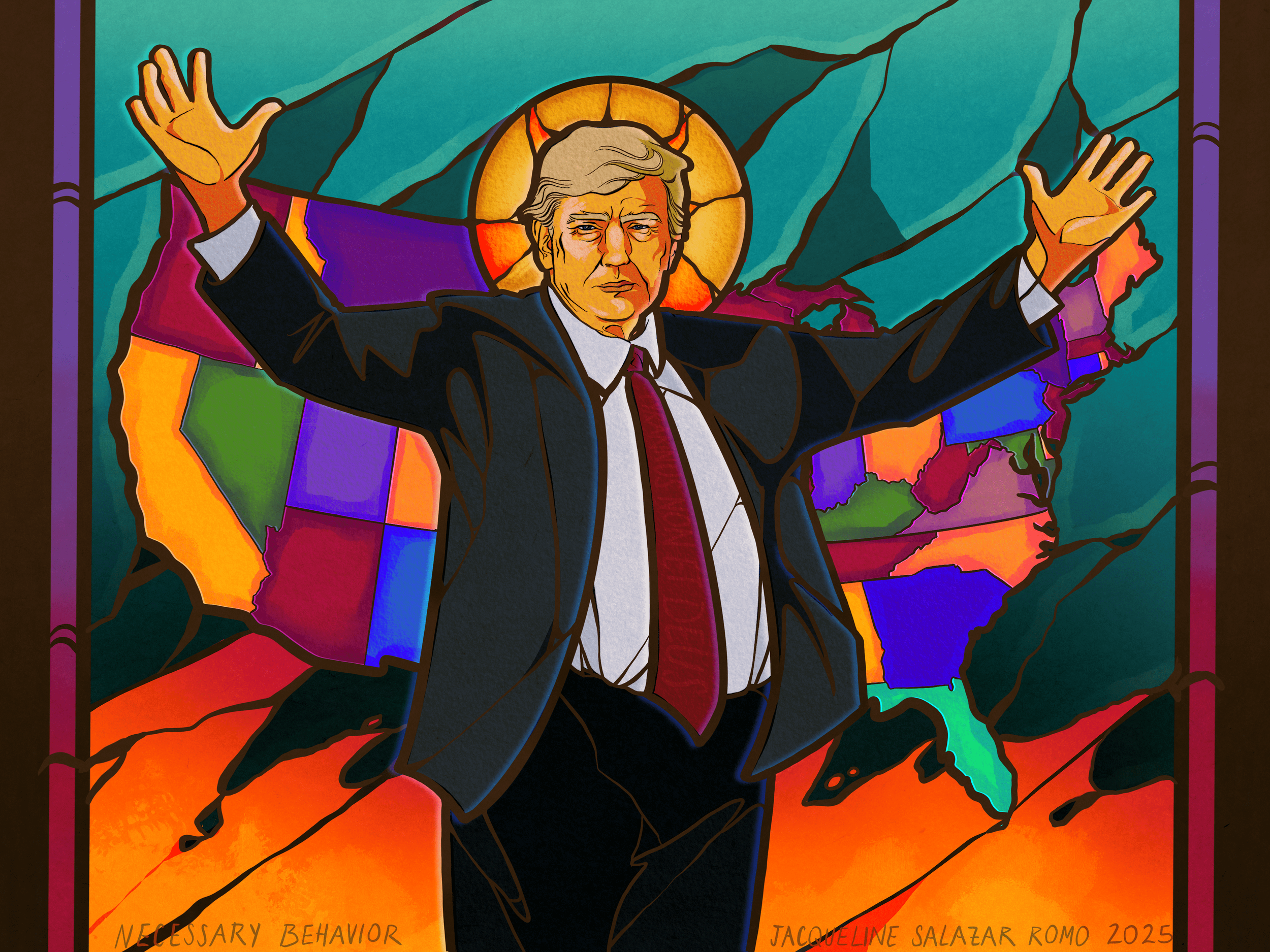
“I pledge allegiance to the flag of the United States of America, and to the republic for which it stands one nation, under God, indivisible, with liberty and justice for all.” You’ve recited this at some point in your life if you’re American, an indoctrinating call to exhibit blind patriotism starting in grade school. And something you may notice is the two-word inclusion of Christianity within the brief pledge: under God, an addendum made to project the country’s strength in faith. From a historical standpoint, the United States of America has always prided itself on being a safe haven for religious refugees, a place where God’s chosen could start anew and found a country worth fighting, praying, and living for. But here’s the thing: despite its roots, the United States of America is far from being truly religious. And thanks to the Trump Administration, nationalists and bigots are emboldened now more than ever to be openly Christo-fascists—and to get away with it.
The Union of Church and State
You’re probably familiar with the phrasing calling for the “separation of church and state” in American politics. These words were first spoken by minister and political philosopher Roger Williams, who founded the settlement of Providence in 1636 and created a community in which there was a distinct separation between civil law and religious doctrine. Then considered radical by Puritan colonials, Williams was a fervent advocate for religious freedom, and his ideas formed what is now known to have been the first documented secular government globally.
Historically, this separation has been a hallmark of American autonomy—the constitutional freedom of religion (as well as the freedom to abstain from it) is protected in the First Amendment within the Bill of Rights, one that has been notoriously and regularly challenged throughout the couple of centuries that the United States has existed. And with the way things are going, this separation will soon become more of a suggestion as the current administration works to strengthen the presence of the church within the government, all to cater to Evangelical voters (more on that later).
These aren’t the only few times you can see the pressure and influence of religious doctrine on the foundations of the country. We already opened with the Pledge of Allegiance, but take something as innocuous as the national motto, for instance. Featured in American currency and on the nation’s Great Seal, the Latin phrase E Pluribus Unum (“Out of many, one”) was suggested in 1776 as a representation of the thirteen colonies’ union, and has enjoyed its longevity and legacy as a stance of the country to this day. You’ve likely seen this slogan of unity printed on currency, over the United States Senate and the House of Representatives chambers, and even in some of the states’ flags. But you would be mistaken in making the assumption that this is the nation’s motto, as the United States did not have a formally recognized one for the roughly first 180 years since its conception—that is, until Eisenhower signed an executive order declaring the phrase “In God We Trust” the official motto for America in 1956.
Yes, Christianity may be historically enmeshed within the American fabric, but it hasn’t always been so in a positive way. Which leads us into talking about the elephant in the (prayer) room.
The Second Coming of Donald Trump
“I believe that my life was saved that day in Butler for a very good reason… I was saved by God to make America great again. I believe that,” Trump declared in one of his addresses to Congress back in March. From his 2020 Bible photo-op during BLM protests to his followers declaring that “God made Trump”, the current President has stirred controversy and secured the Christian patriots’ devotion by an overwhelming majority—up to 80% of his voting pool has identified as white evangelicals, and he also holds the highest approval rating from this group as per the Pew Research Center. His most passionate supporters even liken him to Christ, all actions of blasphemous delusion that to any reasonable Christian would be considered disrespectful at best and outright sacrilegious at worst.
Just this past Monday (May 19), Vice President JD Vance reportedly delivered an invitation to the recently selected Pope Leo XIV to visit the White House. This comes after Vance and Secretary of State Marco Rubio met with the Pope to temper Vatican relations, presumably to be on better terms with the newly appointed head of the global Catholic church. Whether or not these “diplomatic” visits will help the United States’ positioning and religious presence is still to be seen. At the time of writing this article, little is publicly known about the first American-born Pope, only that he is already being attacked by MAGA affiliates for not being “America First,” and that he was not thrilled by the current administration’s actions, ones that are far from Christian in the Pontificate’s eyes. While his Twitter account has since been scrubbed, there were plenty of headlines detailing how then-Cardinal Robert Prevost was critical of Vance’s individualistic comments, sharing an article from the National Catholic Reporter entitled “JD Vance is wrong: Jesus doesn’t ask us to rank our love for others.” Kat Armas, said article’s author, opposes Vance’s “to each their own” mentality, stating that while this framework “makes sense in a world governed by scarcity and fear,” Jesus “speaks of love as abundance—a table where there is enough for everyone.”
It’s important to note that the Trump Administration’s clashes with the Vatican aren’t anything new. The late Pope Francis was openly critical of the President for humanitarian disputes over the fates of the poorest and most marginalized. Given the Pope’s compassion towards the suffering of Palestinians and his constant calls for a ceasefire, as well as his advocacy for immigrants, there could not be more dissimilarities in ideology between himself and the President. About Trump’s calls for a wall in 2016, Francis is reported to have said, “A person who thinks only about building walls, wherever they may be, and not building bridges, is not Christian.” To top it all off, Trump even mused about what it would be like to be Pope, posting a distasteful AI-generated image of himself in the role as millions of Catholics worldwide mourned the fresh loss of one of the most progressive and widely beloved leaders the Vatican has had in recent years.
More than just scuffles with the Pope, Trump’s disingenuous toying with Christianity is also an elaborate marketing ploy. Manvir Singh says it perfectly for The New Yorker: “Trump’s messianic appeal may seem like a twenty-first-century creation, a product of partisan rage, epistemic drift, and American-style evangelicalism… But to treat the right’s politico-mystical fervor as a modern malfunction is to miss its deeper logic. The Trumpian mystique echoes a dynamic that has occurred for centuries and across cultures. Its core ingredients—an alleged league of pedophiles, a godlike miracle worker, promises of an Edenic restoration—resemble archetypes that have long occupied humanity’s imagination. Trump’s followers may communicate through memes and message boards, but their faith belongs to a much older mythology: the eternal face-off between shaman and witch, prophet and cabal.”
Beyond the jokes of Trump or Vance as the Antichrist, this sudden turn toward religion from the administration is chilling in how methodical it is. To Christian nationalists, Trump’s performance replicates the Biblical mysticism of the end times: a world gone astray, a charismatic leader defying the odds and returning to deliver otherworldly justice, a harsh reckoning before the Final Judgement. And it’s through this set of convictions held by the Evangelical conservative that we learn that for them, Christianity is their perfect holier-than-thou excuse to be as cruel as they truly want to be.
No Hate Like Christian Love
About the national motto we discussed earlier, David Mislin writes for The Conversation, “‘In God We Trust’ is… not a motto that reflects universally shared historical values. Rather it represents a particular political, economic and religious perspective – one that is embraced by President Trump and the modern GOP.” With this context, I’d proceed to argue that Christian nationalism is not about the upkeep of faith in a modern world at all—rather, it is wholly disinterested in religion as a moral compass and community pillar, but instead fascinated with it as a tool of rigid hierarchy and control.
Whether it’s within the vitriolic pro-life movement or the anti-LGBTQ+ bigots, or from the anti-immigrant xenophobes to the Zionist-Christian movement, Christianity is likely the religion most often used to justify hatred towards (and dehumanization of) the Other, the marginalized and forgotten. What’s more ironic, these supposed religious zealots act in ways that are antithetical to the core values taught by various Christian authorities and denominations. Where Jesus preached to go beyond the Golden Rule by “‘[loving] your enemies and pray[ing] for those who persecute you’” (Matthew 5:43-48, NIV), the Christian far-right is the most active persecutor of LGBTQ+ people under the guise of “protecting the children” (while turning a blind eye to issues like gun violence and child abuse). Where He declared that “‘it is easier for a camel to go through the eye of a needle than for someone who is rich to enter the kingdom of God’” (Matthew 19:24, NIV), the richest only get wealthier off of the exploitation and labor of the less fortunate. And where Jesus defended an adulterer who was to be stoned, telling her punishers, “‘Let any one of you who is without sin be the first to throw a stone at her’” (John 8:7, NIV), Evangelical patriots will tout their superiority and claim that it’s “woke” for Jesus to have invited his followers to turn the other cheek. See, it was never actually about respecting or following the teachings of the Bible, but about asserting others as inferior beings in order to excuse their own bigotry. This line of thinking is exactly how atrocities like slavery and Manifest Destiny were justified, and how newer cruelties like the Palestinian genocide and the dismissal of pandemic precautions are excused in the name of God.
This context also comes during an era of American legislation that seems to be propagating the resurgence of religious totalitarianism throughout the country. You may recall the controversial Ten Commandments bill (the one decreeing that public schools should display the Ten Commandments in their classrooms) being supported in states like Louisiana, Alabama, and more recently Texas. While opponents to this proposition argue that students’ first amendment freedoms would be violated by the deliberate inclusion of a sole Christian document, this law is already being set into place within some counties. And as Islamophobic sentiments are on the rise, as the world looks away from global injustices in the Holy Land, and with Project 2025’s scope and presence growing within legislation, you can see the cruel hypocrisy of Christian nationalists in full display. It’s said there ain’t no hate like Christian love, and the collective actions of the Christo-fascists of today could not be more emblematic of this saying.
—
As morally righteous and pious that this country claims to be by placing importance on religious conservatism and the freedom to impose it upon its citizenry, America does boast of one major capital sin: that of Pride. Pride in the idolatry of its President and his cruelty, in the rooting and growth of its homegrown Christo-fascism, even pride in the self-aggrandizing revisionism of its history. But there shouldn’t be pride derived from the barbaric origins of the United States, a nation that was built from the exploitation of enslaved people and forged by Indigenous genocide, that used the guise of benevolence and Christianity to harm countless and exert power over the most disenfranchised. Religion is not and should never be a shield that the President or his followers should be able to hide behind, and it’s about time that the American people confront this and offer more than thoughts and prayers to a suffering country.
(Digital illustration by author)
Written by: Jacqueline Salazar Romo
About The Author: Jacqueline (she/they) is an editorial intern who loves writing, whether creatively or within a non-fiction context, especially to explore current issues and personal interests.
Trump Administration, Christo-fascism, Evangelical Conservatism
Sources:
Baehr, Jasmine. "Inside Donald Trump’s Relationship with God, in His Own Words: 'I Was Saved'." Fox News, 13 Apr. 2025, www.foxnews.com/lifestyle/inside-donald-trumps-relationship-god-his-own-words.
Bomboy, Scott. "The History of Legal Challenges to the Pledge of Allegiance." National Constitution Center – Constitutioncenter.org, 14 June 2023, constitutioncenter.org/blog/the-latest-controversy-about-under-god-in-the-pledge-of-allegiance.
Boyle, Keegan. "Supreme Court Rejects Case Challenging ‘In God We Trust’ Motto on Nation’s Currency." JURISTnews - Law Students Reporting the Rule of Law in Crisis, 11 June 2019, www.jurist.org/news/2019/06/supreme-court-rejects-case-challenging-in-god-we-trust-motto-on-nations-currency/.
CBN News. "Lawmakers Across U.S. Push for Ten Commandments in Public Schools: 'Why Would We Not Mention God?'." YouTube, CBN News, 21 Mar. 2025, www.youtube.com/watch?v=r5PJWwDQaYg.
Costa, Robert. 14 Jan. 2024, x.com/costareports/status/1746591492527825327?lang=en.
Detrow, Scott. "Pope Says Trump 'Is Not Christian'." NPR, 18 Feb. 2016, www.npr.org/2016/02/18/467229313/pope-says-trump-is-not-christian#:~:text=%22I%27d%20just%20say%20that,translation%20of%20the%20press%20conference.
Gjelten, Tom. "Peaceful Protesters Tear-Gassed To Clear Way For Trump Church Photo-Op." NPR, 1 June 2020, www.npr.org/2020/06/01/867532070/trumps-unannounced-church-visit-angers-church-officials.
Graham, David A. "The Top Goal of Project 2025 Is Still to Come." The Atlantic, 1 Apr. 2025, www.theatlantic.com/ideas/archive/2025/04/project-2025-top-goal/682142/.
"A History of Christian Nationalism : Throughline." NPR, 10 Oct. 2024, www.npr.org/transcripts/1260150915.
Hudson, John, et al. "Vance, Rubio meet with Pope Leo XIV in push to reset ties with Vatican." The Washington Post, 19 May 2025, www.washingtonpost.com/world/2025/05/19/pope-vance-rubio-trump/.
Iqbal, Nomia, and Mike Wendling. "Maga Criticises the First American Pope As Not 'America First'." BBC Breaking News, World News, US News, Sports, Business, Innovation, Climate, Culture, Travel, Video & Audio, 9 May 2025, www.bbc.com/news/articles/clyglw20lg2o.
Matza, Max. "Trump Criticised After Posting AI Image of Himself As Pope." BBC Breaking News, World News, US News, Sports, Business, Innovation, Climate, Culture, Travel, Video & Audio, 3 May 2025, www.bbc.com/news/articles/cdrg8zkz8d0o.
McCammon, Sarah, et al. "White Evangelical Voters Overwhelming Support Trump. Meet Evangelicals for Harris." NPR, 29 Oct. 2024, www.npr.org/2024/10/29/nx-s1-5159971/white-evangelical-voters-overwhelming-support-trump-meet-evangelicals-for-harris.
McMullen, Angela. "In God We Trust | EBSCO." EBSCO Information Services, Inc. | Www.ebsco.com, www.ebsco.com/research-starters/history/god-we-trust.
Mislin, David. "The Complex History of ‘In God We Trust’." The Conversation, 8 Feb. 2018, theconversation.com/the-complex-history-of-in-god-we-trust-91117.
Peluso-Verdend, Gary. "Why E Pluribus Unum Is a Better Motto for Today Than “In God We Trust”." Phillips Theological Seminary, 31 Aug. 2021, ptstulsa.edu/rpli/why-e-pluribus-unum-is-a-better-motto-for-today-than-in-god-we-trust/.
Rotolo, Chip. "White Evangelicals Continue to Stand out in Their Support for Trump." Pew Research Center, 7 May 2025, www.pewresearch.org/short-reads/2025/04/28/white-evangelicals-continue-to-stand-out-in-their-support-for-trump/.
Salman, Abeer, and Oren Liebermann. "The Pope Called Them Every Night Until His Final Hours. Now, Gaza’s Christians Cling to the Hope He Left Behind." CNN, 23 Apr. 2025, www.cnn.com/2025/04/23/middleeast/pope-gaza-christians-mourning-intl.
Sanneh, Kelefa. "How Christian Is Christian Nationalism?" The New Yorker, 27 Mar. 2023, www.newyorker.com/magazine/2023/04/03/how-christian-is-christian-nationalism.
"Separation of Church & State History (U.S. National Park Service)." NPS.gov (U.S. National Park Service), 31 Oct. 2023, www.nps.gov/articles/000/church_state_historical.htm.
Sherlock, Ruth. "Pope Leo Meets with Vance, Who Delivers an Invitation to Visit the White House." NPR, 19 May 2025, www.npr.org/2025/05/19/g-s1-67583/pope-leo-vance-vatican-white-house-invitation.
Singh, Manvir. "The President Who Became a Prophet." The New Yorker, 17 May 2025, www.newyorker.com/culture/the-weekend-essay/the-president-who-became-a-prophet#intcid=_the-new-yorker-article-bottom-recirc_4802c25d-4306-49a1-8260-e26fcf4bd280_roberta-similarity1.
Slisco, Aila. "Evangelicals Are Now Rejecting 'liberal' Teachings of Jesus." Newsweek, 22 Dec. 2024, www.newsweek.com/evangelicals-rejecting-jesus-teachings-liberal-talking-points-pastor-1818706.
Smith, Peter. "Critics Say Trump's Religion Agenda Will Benefit Conservative Christians the Most." Chattanooga Times Free Press, 20 May 2025, www.timesfreepress.com/news/2025/may/20/critics-say-trumps-religion-agenda-will-benefit-conservative-christians-the-most/.
Sundel, Jenna. "Robert Prevost Criticized JD Vance Months Before Becoming Pope." Newsweek, 8 May 2025, www.newsweek.com/robert-prevost-criticize-jd-vance-months-before-becoming-pope-2069849.
Additional Reading


Check out our social media for more resources:
Leave a comment