
Revisiting Literary Classics: Dorian Gray and a Portrait of Queer Revisionism
Written by: Jacqueline Salazar Romo
June 9, 2025
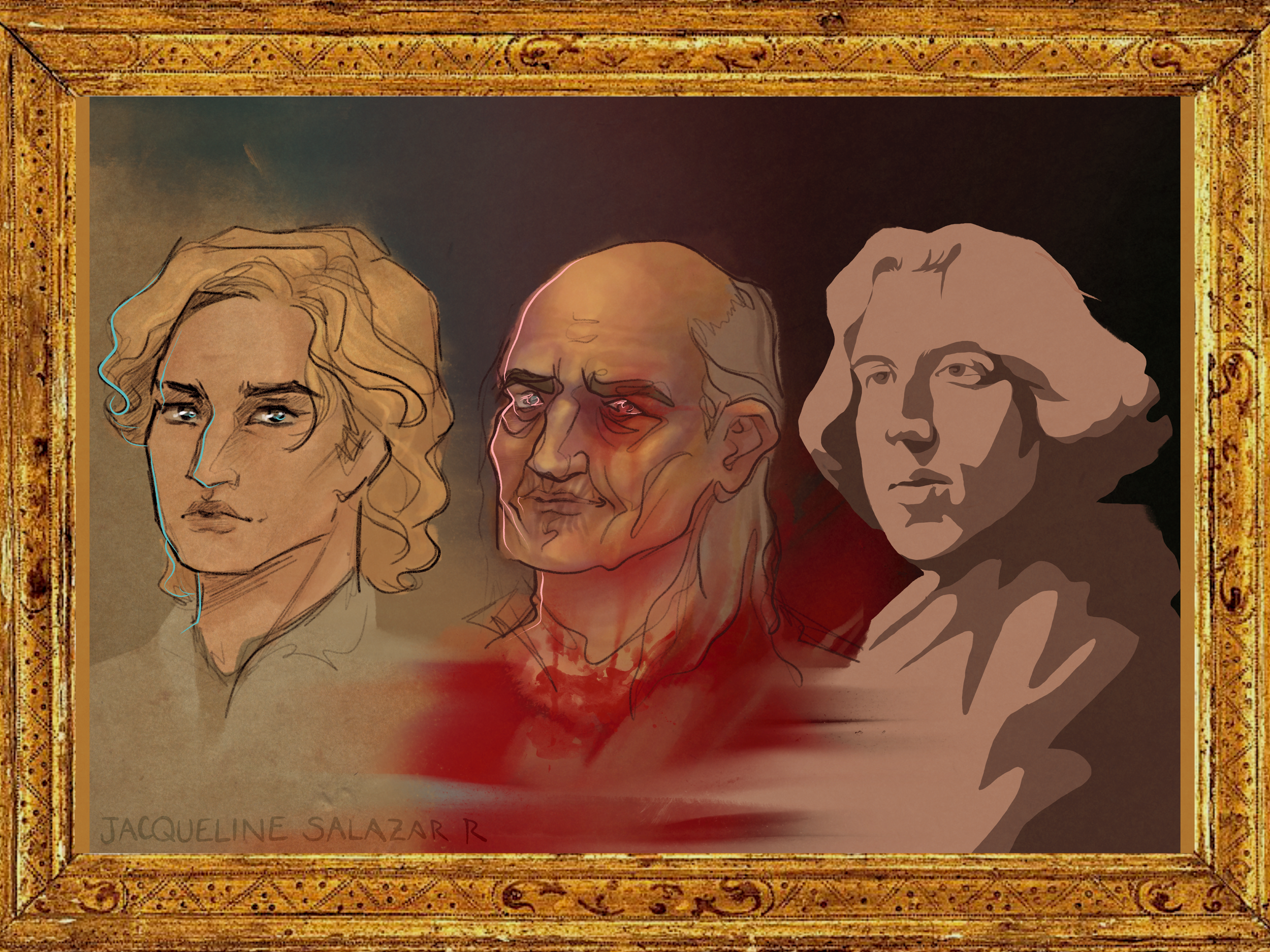
“The books that the world calls immoral are books that show the world its own shame.”
— Oscar Wilde
—
Few people are unfamiliar with the premise of The Picture of Dorian Gray by the influential Irish author Oscar Wilde: Dorian, a young man of impossible beauty and rising social ranking, pursues a hedonistic and morally destructive lifestyle without any seeming consequence. Dermatologists hate him, but he remains physically unblemished over the years! His secret? A portrait that reflects the vile and hideous corruption of his innermost soul in his place.
The trope of the Faustian bargain is by no means new to fiction. However, amidst other narratives of reckless moral abandonment for materialistic or shallow reasons, Dorian Gray may just be the most infamous and dissected novel that follows a protagonist to his perdition. Countless have evaluated the cautionary tale’s themes, from the futility of chasing superficial beauty to the dangerous consequences of arrogance and wanton pride. One of the more recent revivals of the story is through a one-actor Broadway performance by Sarah Snook that implements the modern allure of smartphones and social media. There’s even distressing news of an upcoming Netflix show that will allegedly present the protagonist and Basil Hallward, the painter of Dorian’s titular portrait, as brothers. But despite the myriad interpretations and adaptations it boasts of, there’s a crucial facet of Dorian Gray that caused it to be as controversial as it was when it was published, and that many of these reimaginings happily skim over or erase completely: that of its complex homoerotic and self-inspired context.
While it is presumptuous to assume that Oscar Wilde’s hallmark novel was autobiographical to any degree, art is inherently political - there are presumed to be, of course, snippets of the author’s life and beliefs interspersed within the characterizations of the men that propel the novel’s narrative. There are three who are rumored to have been modeled after Wilde’s own personality, as well as after his real-life acquaintances and lovers. Dorian Gray initially holds a fresh and alluring innocence that attracts the attention (and affections) of both Lord Henry Wotton, an aristocratic dandy who encourages Dorian’s indulgence and vices, and of Basil Hallward, a humble painter who becomes so enamored by Dorian’s beauty and youthful vigor that he’s compelled to paint the portrait that eventually dooms them both. Wilde is said to have remarked that Dorian Gray “contains much of [himself] in it,” saying about these three primary male characters: “Basil Hallward is what I think I am: Lord Henry what the world thinks me: Dorian what I would like to be - in other ages, perhaps.” Evidently, this self-awareness paints a portrait of Wilde as a man grappling with what his sexuality and identity meant to him within a restrictive and unforgiving society. His very work portrays him as someone who sought to reflect on his place as both a creative thinker and social outcast, to test the limits placed upon him by the standards of the time. And it would be his very work that would condemn him.
Relegated to the footnotes of an uncensored edition of The Picture of Dorian Gray, there are revelations of the text that went unseen for decades – a novel that would have been even more overt in its homoeroticism than it was, despite its heavy censorship prior to publication. In the original typescript, for example, there was a moving confession from Hallward to Gray: “It is quite true that I have worshipped you with far more romance than a man should ever give to a friend. Somehow I have never loved a woman… I quite admit that I adored you madly, extravagantly, absurdly. I was jealous of everyone to whom you spoke. I wanted to have you all to myself. I was only happy when I was with you.” Yet this evident and passionate desire was altogether removed before the book’s 1891 publication, and much of the intensity of Hallward’s idealistic love and worship for the young Dorian was reduced to a painter-and-muse dynamic, merely “the painter’s quest for a Platonic ideal in art,” as expressed within this edition’s introduction.
Of his late grandfather’s prose, Merlin Holland explains that Wilde sought to break literary and societal conventions alike within his work, especially when it came to writing Dorian Gray: “I think his whole purpose in writing this book was to break out of the Victorian mould [of] the ‘three-volume novel of more than usually revolting sentimentality’… He does not want, at this juncture of his life, to toe the line and respect social conventions. His purpose is to shock and tweak the noses of the establishment…” (The Guardian 2018).
And shock the establishment he did.
Witty, charming, and as utterly flamboyant as can be, Wilde was an exemplary proponent of Aestheticism, the 19th-century art movement that vouched for “art for art’s sake” – a direct antithesis to an increasingly prude and morally Evangelical Victorian-era society. And while he is now posthumously celebrated as a queer icon, Wilde’s ego and his pride in his identity was strongly weaponized against him in life. The most notorious contribution to his downfall was perhaps his intimate relationship (historians will say they were close friends) with Lord Alfred Bruce “Bosie” Douglas, son of the Marquess of Queensberry. And much like the fatefully cursed portrait was Dorian’s unraveling, Dorian Gray was ultimately Wilde’s damnation, the final nail to the coffin as the novel was used against its own author as evidence in court to criminalize him for “gross indecency.” Wilde was left destitute and ruined when, after raising a defamatory libel case against the accusations of sodomy made by Bosie’s father, the case backfired when evidence of Wilde’s sexual proclivities was presented to the court – his affairs and ventures with men were punished with a grueling two years of hard physical labor, and he left prison with his spirit broken and his name smeared, dying only a few years later.
There may be some comfort to be drawn from assuming that Wilde wouldn’t have been persecuted or ruined if The Picture of Dorian Gray had been written within this past decade. But judging by the way the LGBTQ+ community is being persecuted in the present day, one can no longer be too sure. When it comes to queer revisionism and outright erasure, some of the talking points from Wilde’s times parallel today’s calls against queer works - the excuses of “protecting the children” and the likening of subversive works by queer authors and creatives to obscenity, for instance. While Wilde’s self-censorship most likely stemmed from a goal of self-preservation and the desire to successfully publish Dorian Gray, his novel was regardless reduced further by editors and torn apart by critics - and it’s especially painful to see this erasure given our current battle as queer people to be visible, let alone to be seen. Now more than ever, we’re grappling with how much this historical revisionism is meant to contribute to an epistemicide of LGBTQ+ perspectives. Our stories are being systematically erased, and our portraits are being distorted to justify their destruction.
Queer lives and perspectives should be allowed to be messy, or complex, or “immoral” the way Wilde’s work was in opening discourse around morality, sexuality, and indulgence that would have otherwise never been explored in Victorian-era society — discourse that the novel still invites its readers to engage with to this day. It is within the creation of unapologetic narratives like Dorian Gray that the free exploration of identity and the disruption of conventional tradition often converge for the better. Sanitizing our stories to make them more palatable and “acceptable” to an indifferent public won’t create safer spaces for queer communities — it will only help our persecutors expedite our erasure.
So be unapologetically you — for those who came before you and didn’t get the chance to.
(Digital illustration by author)
Written by: Jacqueline Salazar Romo
About The Author: Jacqueline (she/they) is an editorial intern who loves writing, whether creatively or within a non-fiction context, especially to explore current issues and personal interests.
Literary Analysis, LGBTQ+, Queer Erasure, Revisionism
Sources:
Andreeva, Nellie. "Modern ‘Dorian Gray’ Series In Works At Netflix From Katie Rose Rogers, Rina Mimoun & Berlanti Prods." Deadline, 21 Aug. 2024, deadline.com/2024/08/dorian-gray-series-netflix-katie-rose-rogers-rina-mimoun-greg-berlanti-1236045373/.
Berman, Tosh. "Oscar Wilde's Basil Hallward." The Brooklyn Rail, 30 Apr. 2019, brooklynrail.org/2019/05/criticspage/Oscar-Wildes-Basil-Hallward/.
Birt, AJ. "‘The Love That Dare Not Speak Its Name’: Oscar Wilde As a Gay Icon — The Bristorian." The Bristorian, 28 Feb. 2022, www.thebristorian.co.uk/lgbthistory/oscar-wilde.
Blair, Allison. "“The Picture of Dorian Gray”: They Are Not Just Friends." The Tartan, 23 Sept. 2024, the-tartan.org/2024/09/23/the-picture-of-dorian-gray-they-are-not-just-friends/.
"Celebrating Classic Gay Literature: The Best LGBTQ+ Books." Advocate.com, 20 Mar. 2025, www.advocate.com/books/best-gay-books-all-time.
Dalton, Derian. "Considering The Picture of Dorian Gray and Oscar Wilde Through a Queer Theory Lens – Derian Dalton – Celebration of Student Writing 2023." Pressbooks, 2023, iu.pressbooks.pub/celeb2023/chapter/chapter-1/#:~:text=Dorian%20Gray%20has%20an%20overt,feeling%20and%20style%20(295).
"Faustian Bargain." Encyclopedia Britannica, 19 July 2016, www.britannica.com/topic/Faustian-bargain.
Ferguson, Donna. "Forbidden Love: the Original Dorian Gray Revealed, Direct from Oscar Wilde’s Pen." The Guardian, 8 Sept. 2018, www.theguardian.com/culture/2018/sep/08/oscar-wilde-picture-of-dorian-gray-manuscript-published-forbidden-love.
O'Loughlin, Caitlin, et al. "'It's just filth:' Banned books and the project of queer erasure." PDXScholar: The Institutional Repository of Portland State University, pdxscholar.library.pdx.edu/cgi/viewcontent.cgi?article=1322&context=nwjte.
"Oscar Wilde." Queer Portraits in History, www.queerportraits.com/bio/wilde.
"The Picture of Dorian Gray : an Annotated, Uncensored Edition : Wilde, Oscar, 1854-1900 : Free Download, Borrow, and Streaming : Internet Archive." Internet Archive, archive.org/details/pictureofdoriang0000wild_w6v5/page/4/mode/1up?q=romance.
Pinyerd, Terri. "The Picture of Dorian Gray and the Symbolism of the Self." The Hyacinth Review, 8 Jan. 2024, hyacinthreview.org/terri-pinyerd-the-picture-of-dorian-gray-and-the-symbolism-of-the-self/.
Zax, Talya. “The Most Infamous Narcissist in Literary History Gets a Smartphone.” The Atlantic, 5 May 2025, https://www.theatlantic.com/culture/archive/2025/05/picture-of-dorian-gray-uncle-vanya-social-media/682684/.
Additional Reading

Check out our social media for more resources:
Leave a comment