America Is Banning As Many Books As Nazi Germany

Written By: Grace Mintun
October 6th, 2025
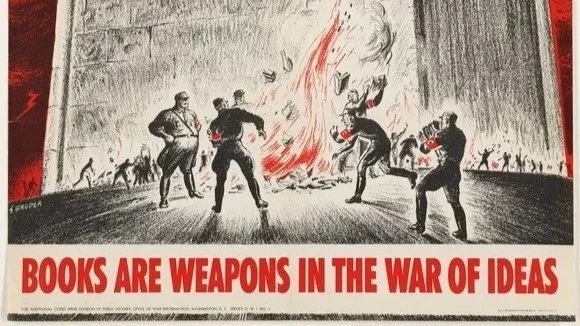
Broder, S. (Artist), Digital Collections, 1942Book banning has been going on since the invention of the written word. Somewhere, there is someone who thinks that you shouldn’t read [insert any book here]. The thing is, this could be for any book that someone doesn’t like, or thinks shouldn’t be shared or read. Any book can be challenged at any time. So if Censorship Suzy over there doesn’t want certain information to be accessed by the general public, all she has to do is challenge it and it can be removed from certain places like libraries, schools, or other venues. It shouldn’t be that easy, but in today’s world, it is.
You may think that the millions of books that Nazi Germany banned and burned are worse than the thousands of books banned today, but in actuality, the number of books counted in the burned books numbers in Nazi Germany included duplicates. The number counted for today’s banned books now does NOT include duplicates. “Since July 2021, the total number of documented bans has reached nearly 16,000” in the United States. That’s 4,000 individual titles a year - at LEAST. In a study done by Guenter Lewy, he found that 5,485 book titles were banned by the end of World War II. Now this doesn’t count every book because some were just burned en masse from whole collections, and not all of it was formally recorded. But let it sink in: we have banned more books than Nazi Germany per this study.
“While an exact total isn't available, it's estimated that Nazi Germany's censorship and book burnings resulted in the destruction of over 25,000 books during the initial, iconic events of May 1933 alone, with millions more falling under ban and seizure in the subsequent years of the regime. These actions were part of a broader effort to control information and ideology, targeting works by Jewish, pacifist, socialist, and other authors deemed ‘un-German’ by the Nazis.” This language is parroted in an article by PEN, saying,
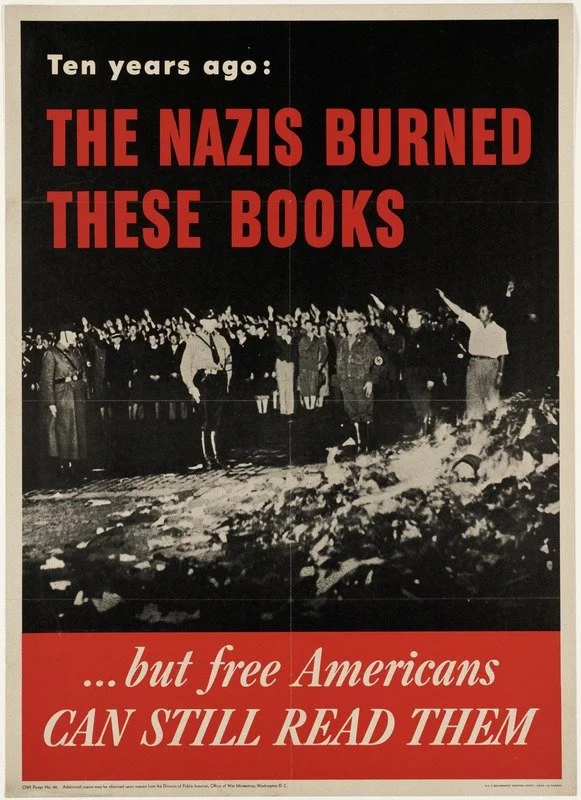
United States, Office of War Information, 1943“Federal efforts to restrict education use rhetoric from state and local efforts to ban books. In 2025, a new vector of book banning pressure has appeared – the federal government. Since returning to office, the Trump Administration has mimicked rhetoric about ‘parents’ rights’, which, in Florida and other states, has largely been used to advance book bans and censorship of schools, against the wishes of many parents, students, families, and educators. Under the guise of ‘returning education to parents,’ President Trump has released a series of Executive Orders (EOs) mainly: ‘Ending Radical Indoctrination in K-12 Schooling,’ ‘Defending Women From Gender Ideology Extremism,’ and ‘Ending Radical And Wasteful Government DEI Programs And Preferencing.’
“Although none of these EOs take a direct aim at books, they were used as justification for the July 2025 removal of almost 600 books from Department of Defense Education Activity (DoDEA) schools on military bases. In restricting discussion of transgender people and diversity, equity, and inclusion and barring schools from ‘promoting un-American ideas,’ books like ABC of Equality by Chana Ewing or several volumes from the series Heartstopper by Alice Oseman were removed from access. Students and their families responded by suing.
“In addition to the efforts from the White House, the U.S. Department of Education declared book bans ‘a hoax…’”
I want to bring up the parallels of un-American and un-German. Both had people in power *clears throat* Dictators who wanted to control ideas through banning media, and in this case, books. By limiting books to fit a certain agenda, it also limits free speech as books are protected under the First Amendment. Banning and limiting books is part of a larger censoring movement in the United States sets a dangerous precedent. “The Supreme Court held that the First Amendment limits the ability of school boards to remove books from libraries, emphasizing that students have a right to access diverse ideas and that school boards cannot remove books simply because they dislike the ideas contained in them.” But in the same breath, this is also true: “Removing a book from a public school curriculum or library or restricting access for some students may violate the First Amendment rights of students and others who have a right to receive information and ideas contained in those books. However, First Amendment protections only apply when these actions are taken by public school or other government officials.” In other words, a police officer can’t ban a book legally, but a parent sure can petition to have a book removed with little to no pushback. That’s a pretty giant legal loophole that is currently being exploited.
The books being limited today are for the following top 10 reasons in the United States as of 2020: sexual content, offensive language, unsuited to age group, religious viewpoint, LGBTQIA+ content, violence, racism, use of illegal substances, “anti-family” content, and political viewpoint. In Nazi Germany, they were being banned topics include: “books written by Jewish, half-Jewish, communist, socialist, anarchist, liberal, pacifist, and sexologist authors among others.” They could even be banned if they were just deemed “degenerate”.
“When Nazis seized libraries full of Marxist books, from Jewish organizations, or from left-wing presses, the first thing that happened was that expert librarians were called in to comb through the stolen books. Nazi librarians actually wanted massive collections of Judaica, about German democracy, on Communism, and about sexuality and gender, but they wanted them closed off from the general public. Only trusted adults should have access to these supposedly dangerous books. As a 1935 Nazi order stated, the goal was ‘to keep German cultural life pure from all harmful and undesirable literature [and this] will particularly protect the youth from corrupting influences.’...Today, if someone assures you that all they want to do is move library books out of general circulation and make them available only to adults to ‘protect the youth,’ while swearing that this is not like Nazi Germany, be wary. Historically speaking, this looks awfully similar to how the Nazis really banned most books. Nazis moved them into special collections to keep them out of the hands of ordinary people.”
The legal loopholes censorship supporters will jump through to limit information and knowledge is astounding. These actions are just making us backslide in critical thinking, empathy, and media literacy. Instead of banning books or trying to circumvent the rules to make sure said books have a limited reach, let’s focus on letting people access the knowledge they have a right to access - we ALL have a right to access. Limiting knowledge doesn’t mean the knowledge doesn’t exist or isn’t important, it just makes it so those in power can better control our information, and, therefore, better control us.
Written by: Grace Mintun
About the author description: Editor in chief and Creative Director at Necessary Behavior
Tags: Censorship, Literature, Banned Books
Check out our social media for more resources:
Additional Reading
Sources
https://www.ala.org/advocacy/intfreedom/censorship#:~:text=The%20right%20to%20speak%20and%20the%20right,art%2C%20film%2C%20music%20and%20materials%20on%20the
https://pen.org/report/the-normalization-of-book-banning/
https://www.washoecountylibrary.us/newsletter/articles/banned_books.php#:~:text=What%20does%20this%20tell%20us,the%20hands%20of%20ordinary%20people
https://www.washoecountylibrary.us/newsletter/articles/banned_books.php#:~:text=The%20Nazis%20banned%20books%20in%20a%20number,*%20Mass%2Dproduced%20magazines%2C%20newsletters%2C%20and%20informational%20handouts
"Book Burning". History Unfolded: US Responses to the Holocaust. United States Holocaust Memorial Museum.
Leave a comment