
The Odyssey: Artistry in the AI Era

Written By: Lucy Newton
Date: August 31st, 2026
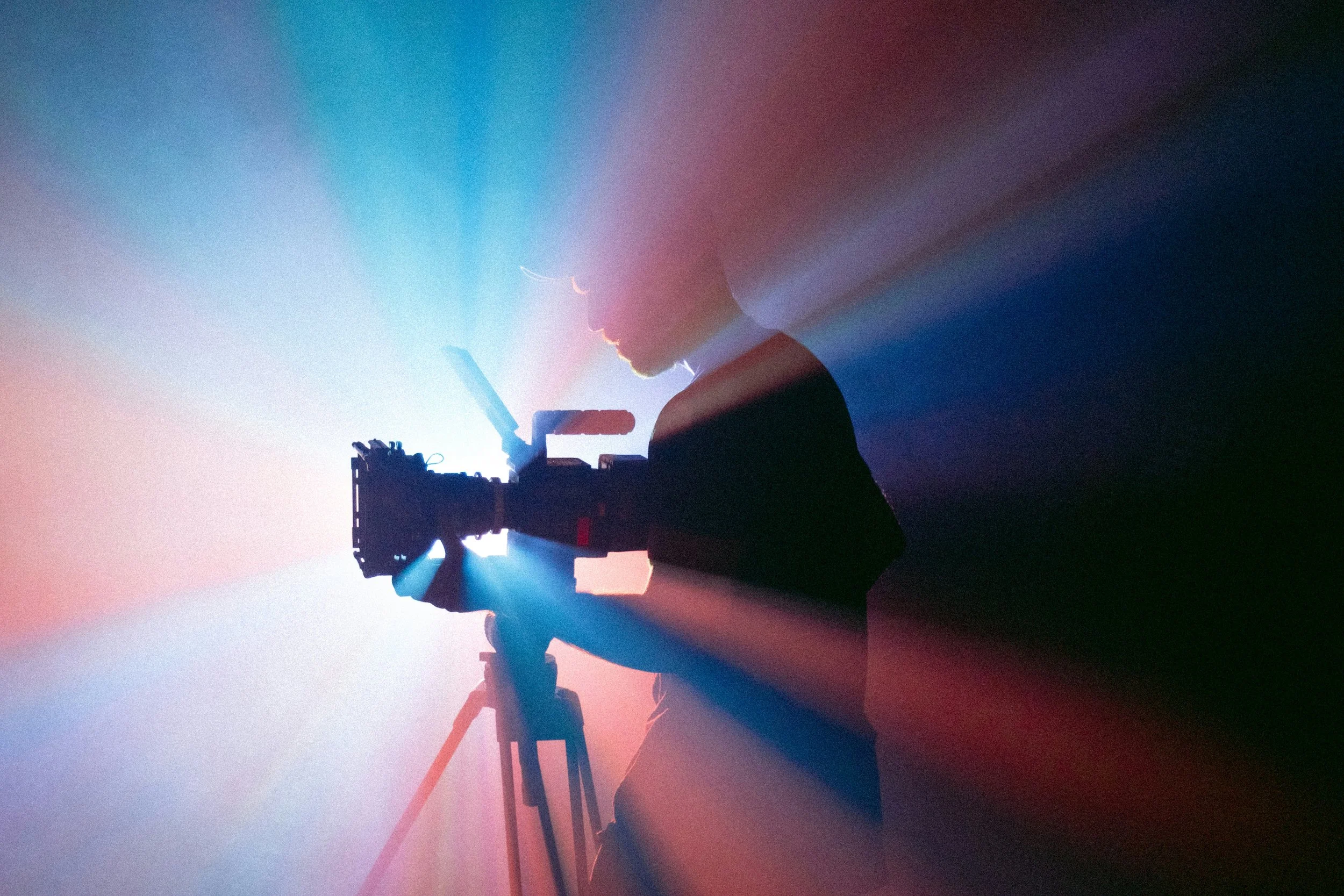
Photo by Jakob Owens on UnsplashSince the release of his feature-length debut, Following, film director and screenwriter Christopher Nolan has dramatically impacted the film industry. Nolan’s groundbreaking projects over the last 28 years—including Inception and Interstellar, among a handful of other box-office hits—set the stage for his newest film, The Odyssey, released in theaters on July 17th. Yet, Nolan’s newest blockbuster has not only been met with immense praise and success, but also with a slew of controversy.
Nolan’s newest piece of work is groundbreaking, featuring a star-studded cast (including Matt Damon as Odysseus, Anne Hathaway as Penelope, Tom Holland as Telemachus, Zendaya as Athena, and Robert Pattinson as Antinous, among countless talented actors). Nolan’s directorial work prodded nuanced performances out of each actor—causing audience members to both hate and love the portrayed characters, sometimes all at once.
Complementing the emotionally demanding performances, The Odyssey boasted undeniably stunning frames that demand to be seen on the big screen . The film’s outstanding cinematography can be largely attributed to director of photography Hoyte van Hoytema, who also collaborated with Nolan on Interstellar and Dunkirk. Moreover, much of the film was shot all across the globe; scenes based in Troy were shot in Morocco, and those set in Ithaca were “filmed on the island of Favignana near Sicily.” To supplement the footage captured on-location, the film crew additionally shot scenes at the “Universal Studios backlot area known as Falls Lake,” which was often used when capturing Odysseus and his crew aboard their ship.
Nolan’s demanding, rigorous production schedule, which took a cast and crew across the globe and back, was not only an impressive feat—it has become a commentary on the potential for the immense beauty, emotion, and simply outstanding art that can be channeled via manmade collaboration and devotion. In an industry that has faced explicit and implied threats from the growing use of artificial intelligence (AI) to achieve dramatic and realistic special effects, Nolan’s epic has presented an outstanding counterargument.
Nolan, however, likely doesn’t view his work as a counterargument at all—but simply the mode of creation that is purest and most true to himself. After all, when prompted about AI’s use in film production, Nolan articulated that he “think[s] the idea that it replaces human beings wholesale and human creativity…[is] nonsense.”
Not relying on AI tools to generate the epic’s outrageous visual effects, Nolan and his crew undoubtedly faced creative hurdles in creating the Odyssey’s realistic visuals. These hurdles, however, did not negate the quality of the end result; if anything, they made them all the more impressive. The creative problem-solving of the cast led to the creation of “pig animatronics” for the iconic scene featuring Circe, and the construction of a “giant puppet…to [bring] the Cyclops to life.” Moreover, the crew built “multiple 35-foot-tall [Trojan] horses,” one of which was actually “submerged on the beach and really had men pull it from the sand and roll it” towards Troy to acquire a feel that was “as authentic as possible.” As for the enormous whirlpool, it, too, was a practical effect created via circling jet-skis—and Scylla’s attack was a true rig which pulled stuntmen from the deck of Odysseus’ ship.
The authenticity of Nolan’s work, and of his creative ambition, undeniably shined through in the film. In moments of horrifying attacks, resonances of fear ripple through the audience, and in moments of long-awaited reunification, echoes of relief and heartache are found in the theater.
Despite the obvious success of his work and the clear benefits reaped from his process, Nolan’s steadfast belief in the importance and individuality of human-centric creation is, in short, not universal.
Shortly after the release of The Odyssey, Elon Musk made a post on X, which “promised that before the year is out, his AI tool Grok Imagine will produce a full-length film of Homer’s Odyssey that is ‘historically accurate and true to the art of Homer.’” While Musk has expressed dismay over some of Nolan’s choices in his film, for instance, “his choice to have the Black actress Lupita Nyong’o play Helen of Troy and the trans actor Elliot Page play the warrior Sinon,” critics of Musk have speculated that his outrage over these casting choices is likely masking a different ideological divergence between himself and Nolan—the matter of AI use. The New York Times columnist Michelle Goldberg masterfully points out that Musk’s promise of an AI Odyssey “inadvertently highlighted one reason Nolan’s ‘The Odyssey’ is so powerful—because it represents a revolt of the human in a world overstuffed with AI slop.”
This argument is not just about whether you believe AI is a force of good or a force of evil. After all, as with most things in the world, AI likely falls in a gray area, a nuanced middle ground that is not purely anything. Instead, it will likely pose us with a moral question that we can exhaust without ever concretely reaching a conclusion.
Rather, the debate between Nolan and Musk illuminates that there are shortcomings with any argument or stance that is unquestioningly conclusive, without any regard for the limitations of one’s belief. Nolan created a piece which did not depend on AI, but on human creativity. Regardless, Nolan is not inherently, entirely opposed to any form of AI; a piece in The Guardian discloses that Nolan articulated that “he expected AI to result in some useful ‘imaging tools’” in the world of film-making. Nolan’s nuanced understanding outlines the empathetic, admirable approach he brings to the world, an approach we should all aim to acquire. Rather than write off AI altogether, Nolan acknowledges its merits, but creates art in a human-centered manner regardless. What better approach could we have to the world?
It is still to be determined how Musk’s AI-fueled rendering of Homer’s epic will fare, but I believe that Nolan’s approach to art in a world of AI can provide insight and wisdom to all consumers, creators, and individuals in the modern day.
While consuming art, or simply going about your day interacting with manmade beauties, small and large, consider Nolan’s thoughts regarding AI—and carry them with you in your personal efforts, whether creative or not. “I think AI is a Trojan horse that everybody knows the Greeks are inside. It’s a transparent horse; it’s made of glass,” articulated Nolan, urging us to exercise “healthy skepticism, because technology is always going to give us great gifts…but it has to be viewed with skepticism.”
Instead of fixating on the detriments and ignoring the gifts, create anyways—acknowledge the nuance, and move forward.
Written by: Lucy Newton
About the Author: Lucy Newton (she/her) is an Editorial Intern at Necessary Behavior. She is currently pursuing her undergraduate degree at the University of California, Santa Barbara, exploring English, Economics, and Film & Media Studies.
The Odyssey, Christopher Nolan, Artificial Intelligence
Check out our social media for more resources:
Additional Reading
Leave a comment