Fascism 101: Analyzing Umberto Eco’s Steps Under the Trump Administration
Written By: Jacqueline Salazar Romo
Date: October 21, 2025
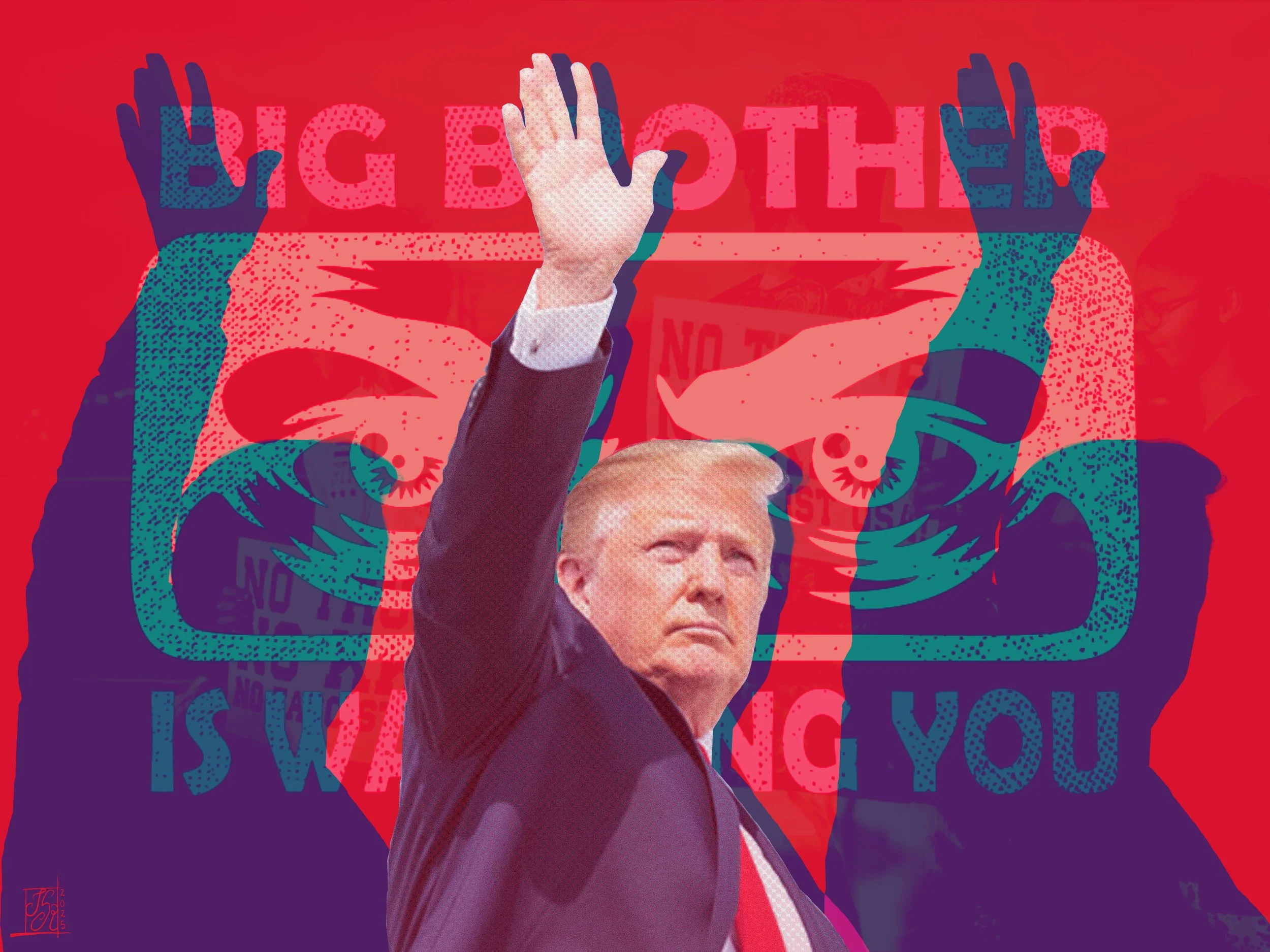
(Digital illustration by author)
This past Saturday, anti-Trump demonstrators gathered for a second round of No Kings rallies—and not just on a national level, as these protests have gathered global support. But what about this presidential administration has mobilized and polarized so many, to the point where attendees prop up signs calling for a fight against fascism? We’re here to talk about the fourteen telltale “steps” of fascism, which are majorly attributed to Umberto Eco. Eco, an Italian philosopher and sociopolitical commentator who grew up under Mussolini’s regime, identified these components of “Ur-Fascism” in an essay published in The New York Review. I’ll be highlighting these steps, alongside some of his commentary, and adding some thoughts.
The cult of tradition. Eco describes “traditionalism” displayed in this first step as formative of a culture that has to be syncretistic; that is, a combination “of different forms of belief or practice… [that] must tolerate contradictions” made up of messages that, even if incompatible, all allude to “the same primeval truth.” While not exclusive to this subset, traditionalism of this nature often can look like an integrated aspect of religious (especially Christian) conservatism—think of the binary, measured way of thinking found in the Church’s teachings, and how the Church has historically pushed back against science and new knowledge, from the emergence of Greek rationalism to the Enlightenment period and beyond. But again, traditionalism is not a singular occurrence, nor is it only present in Evangelical doctrine. There are plenty of examples of the push toward “traditional values” in America— the uptick in popularity of tradwife content, the romanticization of androcentric dynamics, and the encouragement from the current administration to “have more babies,” all of which point to an unnerving obsession with imposing the nuclear family as the only acceptable societal norm. And while it is obviously perfectly fine to want to have a spouse and children, this push for a “return” to the family model comes packaged with bioessentialist gender roles and unbalanced power structures. Not only that, it is especially heinous of the current pro-natalist administration to demand a growing birthrate, all while working to strip reproductive rights and limit or outright persecute initiatives and legislation that actually supports parents and couples seeking to have children. The same party that claims to be “pro-life” also demonizes families that may need welfare assistance, rejects policies that would help parents spend more time with their children (whether it be maternity leave, equitable pay, or childcare assistance), does not want children to receive free school lunches, and limits access to contraception and sex education, all in the name of family. “Traditional values,” then, are only important to the conservative voter when it involves the control of birthing individuals—never mind that Trump himself has never embodied the values of a God-fearing, down-to-earth family man.
The rejection of modernism. This point is closely related to the previous; about this step, Eco makes references to the Nazi regime: “Both Fascists and Nazis worshipped technology, while traditionalist thinkers usually reject it as a negation of traditional spiritual values. However, even though Nazism was proud of its industrial achievements, its praise of modernism was only the surface of an ideology based upon Blood and [Soil] (Blut und Boden)... The Enlightenment, the Age of Reason, is seen as the beginning of modern depravity” (for anyone who may be wondering what “Blood and Soil” is, the United States Holocaust Memorial Museum elaborates: “[Blut und Boden] was an early Nazi slogan used in Germany to evoke the idea of a pure ‘Aryan’ race and the territory it wanted to conquer… Blood referred to the goal of a ‘racially pure’ Aryan people. Soil invoked a mystical vision of the special relationship between the Germanic people and their land. It was also a tool to justify land seizures in eastern Europe and the forced expulsion of local populations in favor of ethnic Germans”). Simply put, Eco makes this point to allude to the weaponization of technology as a tool for the propagation of fascism. We’ve written about Artificial Intelligence (AI) and its role in expediting technofascism before, but consider its profoundly anti-human nature (data centers being detrimental to the environment, LLMs being notoriously trained on stolen sources, AI fanatics using it to harass others, and the “tool” just being a way to outsource the act of thinking entirely) and its role becomes even clearer.
The cult of action for action’s sake. “Thinking is a form of emasculation.” Taking action before (or without) reflection and a distrust of academia and free thought are both symptoms of a fascist-leaning culture that perceives intellectualism and diversity of opinion to be dangerous, perhaps even “degenerate” or depraved. And you can see traces of these symptoms in the 2024 presidential election, in which young male voters especially may have voted red to “reclaim” their sense of power and control in the sociopolitical hierarchy (more on that later). And in an increasingly anti-intellectualist environment, those who take action for action’s sake can get away with not having reasonable justifications. Much like how Trump pardoned the January 6th insurrectionists who stormed the Capitol after his loss, any measures or actions taken to uplift the administration are deemed heroic and redeemable, no matter how violent or cruel the approach is—the ends justify the means.
Disagreement is treason. “No syncretistic faith can withstand analytical criticism. The critical spirit makes distinctions, and to distinguish is a sign of modernism.” Do I even have to elaborate on this one? In a fascist state, the authority in power and its followers reject any opposing arguments, demonizing and criminalizing dissenters as “traitors.” And in the Trump Administration, you’ve seen it time and time again, whether it be in his relentless persecution of his political opponents, in the cancelling and censorship of everything from late-night talk show hosts to public media and news outlets, or in the petty attacks on student protestors and university campuses.
Fear of difference. “The first appeal of a fascist or prematurely fascist movement is an appeal against the intruders. Thus Ur-Fascism is racist by definition.” Racism, xenophobia, ableism, misogyny, anti-LGBTQ+ sentiments; all of these types of marginalization and bigotry ultimately culminate into the prevalent “Us vs. Them” mentality that is so ingrained into the very fabric of American exceptionalism. This ideology also contributes to the major conservative push against Diversity, Equity, and Inclusion (DEI). Instead of examining their bigoted prejudices against marginalized communities (especially against Black Americans and other members of the BIPOC collective), the far-right calls for the homogenization of American culture. Where DEI initiatives seek to address unfair disparities and work toward repairing the systemic inequalities created throughout history, conservatives claim that these opportunities to include underrepresented groups in the conversation are discriminatory against them (namely, white, middle-to-upper-class, right-leaning “patriots” who believe they are solely entitled to the American Dream).
Appeal to social frustration. Eco identifies how “one of the most typical features [of] historical fascism was the appeal to a frustrated middle class, a class suffering from an economic crisis or feelings of political humiliation, and frightened by the pressure of lower social groups.” As a presidential candidate, Trump was quick to identify the pain points, such as high grocery costs, of the disenfranchised moderate, and to make scapegoats of his political opponents. Taking advantage of the discontentment with Biden’s presidency, Trump succeeded in securing a second term largely because of the way he positioned himself as the “solution.” However, the United States economy has been fickle and unstable for several years now, and as unemployment rates keep climbing and foreign relations seem uncertain, Americans are still frustrated by the state of the country.
The obsession with a plot. “To people who feel deprived of a clear social identity, Ur-Fascism says that their only privilege is the most common one, to be born in the same country. This is the origin of nationalism. Besides, the only ones who can provide an identity to the nation are its enemies. Thus at the root of the Ur-Fascist psychology there is the obsession with a plot, possibly an international one.” Simply put, a quintessential hallmark of American exceptionalism is fear.
We’ve already begun exploring how an identity founded upon nationalism functions to make its people afraid of everything that is perceived to be antithetical to the traditional values the nation claims to operate under. Ironically, American individualistic culture provides a framework for an identity that places patriotism, pride in one’s country, as a sole unifying force. It’s not “good enough” to be American, because “being American” is something to take pride in only if you share the hostile, anti-diverse, and anti-progressive values and ideologies that support capitalism, militarization, and xenophobic narratives. American fascism demands the manufacturing of an enemy from the unknown—despite boasting of the most powerful and well-funded military forces and involving itself in international conflicts, America portrays itself as defenseless and endangered. Someone somewhere is “out to get us,” the heroic military is “fighting for our freedom” in war-torn and depleted countries overseas, other nations that don’t support the administration are “a threat to democracy,” you get the picture. But this deluded paranoia is nothing new; you can look back to the restlessness of the Cold War period, where McCarthyism propelled the Red Scare, and even more recently, to the “War on Terror” brought forth after the tragedy of 9/11.
No matter the scenario, somehow there’s always someone out to harm Americans—and somehow, all measures of violence against these perceived threats are justified.
The enemy is both strong and weak. It sounds ridiculous and oxymoronic, but it’s unfortunately another distinctive facet of the “Othering” that comes with fascist systems of government. In this way, “fascist governments are condemned to lose wars because they are constitutionally incapable of objectively evaluating the force of the enemy.” There are plenty of enemies identified by the Trump Administration, but let’s begin with the “radical far-Left.” Somehow, Democrats are simultaneously “woke soyboys” and “violent instigators,” too sensitive and soft and yet capable of destroying the nation with their ideology alone. From their perspective, the same is true for BIPOC and immigrant communities in America: they are underqualified and inadequate for the jobs they are supposedly stealing from white Americans in droves. It’s even a contradiction that they use against the LGBTQ+ community (and even more so against trans people lately). Trans women are constantly harassed, assaulted, and labeled “men in dresses” to make them seem a danger to cis women, and yet these same “predatory men” are emasculated and weak; in the same way, gay men are labeled effeminate and cowardly, but are also a source of distress and fear for the conservative parent the second they perform in drag. While these are but a few examples out of many (all were at a domestic scale, so let’s not even imagine involving other countries), they encapsulate the essence of the current conservative sentiment, composed of a contradictory but functional mix of pitying self-victimization and an overinflated superiority complex.
Pacifism is trafficking with the enemy. Trump has made his disdain for his opponents clear countless times. One of his most recent jabs at his enemies happened at the Charlie Kirk memorial event, where, after Erika Kirk claimed to have forgiven the man who shot her husband, implying that it’s what he would have wanted, Trump took to the podium to say, “That’s where I disagreed with Charlie. I hate my opponents. And I don’t want the best for them” (so much for an administration that glorifies Trump as “the President of Peace”).
Contempt for the weak. “Ur-Fascism can only advocate a popular elitism. Every citizen belongs to the best people of the world, the members of the party are the best among the citizens, every citizen can (or ought to) become a member of the party. But there cannot be patricians without plebeians.” When it comes to identifying the “weak” that are targeted by the Trump Administration, the disabled are one of the most immediate abandoned groups that comes to mind. With the defunding of public health and scientific organizations left and right, the Trump Administration is ensuring that RFK’s unfounded claims about Tylenol causing autism and vaccines being bad for you are upheld and propagated as fact (which is very concerning, as news outlets continue to report a drastic decrease in childhood vaccination rates nationwide). Moreover, the MAGA crowd has never been quite receptive to following public health guidelines, loudly opposing lockdowns, vaccination efforts, and mask mandates throughout the ongoing COVID-19 pandemic. Beyond childhood vaccination debates and even COVID, though, the blatant public health disinformation campaigns being run by the administration can, and will, only harm, disable, and even end up killing Americans—disability can come to affect everyone, and repeated infections, alongside failing public health protections and outlandish insurance costs, will render life-saving measures inaccessible.
But it doesn’t stop there. Another neglected community greatly affected by Trump’s policies is the unhoused/homeless population. While not unique to this administration, the demonization of homeless Americans has only increased, with Trump enforcing criminalizations and prosecutions in the name of “Ending Crime and Disorder on America’s Streets.” Public sentiment also seems to be more hostile, and Fox News host Brian Kilmeade’s remark that people experiencing mental illnesses or homelessness should be executed (“Involuntary lethal injection or something… Just kill ‘em”) unfortunately did not cause the outrage it should have. The Trump Administration seeing disabled and unhoused communities as disposable and deplorable isn’t just atrocious; it’s outright eugenics.
Everybody is educated to become a hero. “The Ur-Fascist hero craves heroic death, advertised as the best reward for a heroic life. The Ur-Fascist hero is impatient to die. In his impatience, he more frequently sends other people to death.”
Machismo and weaponry. Previously, I’d written about how the Trump campaign capitalized on these feelings of disenfranchisement that were present especially in Gen Z men, given that “as social settings have grown to be more inclusive of underrepresented demographics over the past few decades, men (who have historically been more empowered and who benefit the most from said power dynamics) may especially feel left out of the mix.” Trump’s silent promise to “recenter [men] in the political conversation” paid off, as they overwhelmingly voted for him in the 2024 electoral race and helped him attain his victory. With a patriarchal government back at the helm, the country’s leadership has also doubled down on investing in military force. During a recent summit at Marine Corps Base Quantico, Secretary of Defense Pete Hegseth declared that the military would “restore a ruthless, dispassionate, and common sense application of standards,” as well as calling for the reinstatement of a “warrior ethos,” giving orders on “upholding male standards for combat roles, reforming military equal opportunity, [and]... [eliminating] anything that is not directly tied to what DoD officials consider to be lethality and warfighting,” as Chris Panella wrote for Business Insider. In the administration’s words, your masculinity and your worth to your nation is directly tied to your willingness to be a weapon for it.
Selective populism. “Wherever a politician casts doubt on the legitimacy of a parliament because it no longer represents the Voice of the People, we can smell Ur-Fascism.” If you go to any government website at the moment, you’ll see a notice at the top that reads something like “DEMOCRATS HAVE SHUT DOWN THE GOVERNMENT” (referring to the current government shutdown entering its third week). This is one of the ways that the Trump Administration UC Berkeley researchers have used the term “authoritarian populism,” first coined by theorist Stuart Hall in 1979, to describe Trump’s (and other leaders’) style of government. Pure authoritarians often “suppress political opposition, spread disinformation, fuel political violence and turn historically independent institutions into political actors that will help achieve their agenda. They typically use coercion to achieve these goals… [and] justify their grip on power by fanning the flames of emotionally charged topics and scapegoating marginalized groups.” Populism, meanwhile, “occurs when leaders rhetorically divide the population into two groups: the majority versus the elites. These leaders position themselves the true representatives of the majority group. This anti-establishment ‘us-versus-them’ struggle is at the center of populist rhetoric.” Trump’s very style of politics is emblematic of this type of selective populism; despite his campaigning as the underdog and a man of the people, he is quick to antagonize and even people within his own Party.
Newspeak. In reference to George Orwell’s 1984, Umberto Eco describes the final step toward fascism as “Newspeak.” If you’re unfamiliar with the aforementioned dystopian novel, the term refers to a fabricated, overly simplistic language and form of communication. Its syllabically brief vocabulary and ambiguous format is intentional; by design, Newspeak works to limit a person’s ability to articulate and think critically. And this “language” is unfortunately not constrained to the boundaries of fiction. Eco notes that “all the Nazi or Fascist schoolbooks made use of an impoverished vocabulary, and an elementary syntax, in order to limit the instruments for complex and critical reasoning.”
Written by: Jacqueline Salazar Romo
About the author: Editorial Staff at Necessary Behavior
Tags: US Politics, Fascism, Trump Administration
Check out our social media for more resources:
Additional Reading



Sources
https://www.theguardian.com/books/2025/feb/25/how-to-spot-a-fascist-the-umberto-eco-way
https://necessarybehavior.com/tips-on-how-to-stay-safe-while-protesting
https://www.openculture.com/2024/11/umberto-ecos-list-of-the-14-common-features-of-fascism.html#google_vignette
https://goodfaithmedia.org/anti-science-christians-have-long-history/
https://millercenter.org/the-presidency/educational-resources/age-of-eisenhower/mcarthyism-red-scare
https://www.ushmm.org/antisemitism/what-is-antisemitism/origins-of-neo-nazi-and-white-supremacist-terms-and-symbols
https://seabass-swordfish-cbee.squarespace.com/all-the-words-donald-trump-is-taking-out-of-use-within-anything-controlled-by-the-government
https://www.cbsnews.com/news/trump-support-among-men-reshaped-the-political-landscape/
https://www.thelancet.com/journals/lancet/article/PIIS0140-6736(24)02603-5/fulltext
https://www.politifact.com/article/2025/apr/21/rfk-jr-exaggerates-share-of-autistic-population-wi/
https://www.theguardian.com/us-news/2025/sep/25/trump-cdc-budget-cuts-chronic-illness
https://www.unmc.edu/healthsecurity/transmission/2025/10/08/even-small-drops-in-vaccination-rates-for-us-children-can-lead-to-disease-outbreaks/
https://www.nytimes.com/2025/09/23/us/politics/trump-covid-autism-science.html
https://www.whitehouse.gov/presidential-actions/2025/07/ending-crime-and-disorder-on-americas-streets/
https://www.pbs.org/newshour/show/at-kirk-memorial-trump-escalates-promises-of-political-retribution-against-his-enemies
https://www.theguardian.com/commentisfree/2025/oct/17/donald-trump-president-peace-civil-war-national-guard
https://www.businessinsider.com/hegseths-warrior-ethos-speech-now-mandatory-viewing-for-military-2025-10
https://www.yahoo.com/news/articles/government-shutdown-third-week-means-223209042.html
https://www.theguardian.com/us-news/ng-interactive/2025/sep/27/trump-free-speech-charlie-kirk
https://theaggie.org/2025/10/21/nationwide-censorship-has-severe-consequences-on-freedom-of-press/
https://www.pbs.org/newshour/nation/mahmoud-khalil-asks-appeals-court-to-block-trump-administrations-efforts-to-deport-him
https://www.cnn.com/2025/10/16/us/trump-universities-compact-funding
Leave a comment